















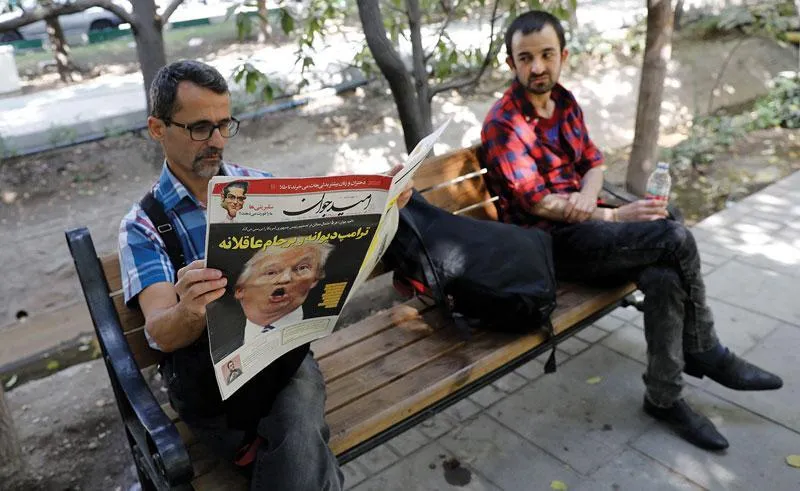
An Iranian man reads the daily newspaper Omid Javan, with a picture of President Donald Trump on the front page and a headline that reads in Persian, “Crazy Trump and Logical JCPOA,” on a bench in front of a kiosk in Tehran, Oct. 14, 2017. (STR/AFP/GETTY IMAGES)
Washington Report on Middle East Affairs, November/December 2017, pp. 8-10
Two Views
Trump Shoots the U.S. in the Foot Over Iran
By Eric S. Margolis
PRESIDENT DONALD TRUMP has put the United States on the course for war with Iran. That was clearly his objective Oct. 13, when he refused to certify the international nuclear accord with Iran and proclaimed heavy sanctions against Tehran’s powerful paramilitary Revolutionary Guards Corps.
Trump’s move was also a clever ploy to deflect blame for abrogating the key 2015 Iran nuclear treaty that the U.S. signed with Iran, Britain, France, Germany, Russia, China and the European Union.
Accusing Iran of “terrorism” and “violating the spirit of the accord,” Trump threw the Iran issue into the hands of the Republican-dominated U.S. Congress. He had to. All of Trump’s senior national security officials and those from the treaty partners and U.N. reported that Iran had kept its end of the deal.
So Trump trotted out the old song and dance about terrorism—which means anything Uncle Sam does not like. The same United States that supports the murderous Islamic State and its allies in Syria and Iraq.
There won’t be much doubt about how Congress handles this hot potato. The leading senators and congressmen who will deal with the issue, like Bob Corker, Tom Cotton and Marco Rubio, are all firmly in the pocket of pro-Israel lobbies.
The U.S. vociferous ambassador to the U.N., Nikki Haley, is almost a wholly owned subsidiary of the Las Vegas gambling mogul and über Zionist billionaire Sheldon Adelson—who is also a key financial backer of Trump and Netanyahu.
In fact, Israel’s Prime Minister Binyamin Netanyahu appears to have more influence on Capitol Hill than President Trump. He used to show it off by humiliating former President Barack Obama.
Israel has just scored a major triumph by using Trump to sabotage the Iran nuclear pact. Prime Minister Netanyahu has long been adamant in insisting that the pact be scrapped. Having pushed the U.S. to destroy its old foes, Iraq and Syria, Israel now has its big guns trained on Iran, the last regional power that can challenge Israel’s domination of the Mideast. Iran, we should remember, is also the only important Mideast power backing the Palestinians and calling for a Palestinian state.
Trump is surrounded by a coterie of ardently pro-Israel advisers and cronies aligned to that nation’s far right wing. So far to the right, in fact, that their Israeli opponents often call them “fascists.” Trump, with this Mussolini complex, fits right into this mind-set.
In addition, Trump’s virulent hatred of Islam and his deep support from America’s evangelicals fuel his antipathy to Iran. The Israeli lobby and so-called Christian Zionists that make up his electoral base are beating the war drums against Iran.
If the Iran nuclear deal is abrogated, America will have shot itself in the foot and shown the world it has fallen under the control of special interests for whom America’s national interests do not come first. Europe, already disgusted by the Trump carnival in Washington and its religious supporters, will pull further away from the U.S. and closer to Russia and China. Who would trust America’s word after deal-breaker Trump?
Europe has lately signed billions in new trade accords with Iran, most notably an $18 billion deal with Airbus for the sale of commercial aircraft. Boeing wants to sell 80 aircraft to Iran worth $16 billion. Thus Trump’s jihad against Iran will likely deny high-paid jobs to tens of thousands of American workers. This from the president who was going to create jobs, jobs, jobs.
Iran handed over 10 tons of medium-enriched uranium as part of the nuclear deal. Will Tehran get this trove back if Congress scuppers the Iran deal? Doubtful. Iran destroyed many of its uranium centrifuges as part of the deal. Can it sue Washington for breach of contract?
Meanwhile, the U.S. heads toward some sort of military conflict with Iran at a time when it may go to war any day with North Korea. Trump, who evaded the draft during the Vietnam War due to a trivial foot problem, is now clearly thrilled by all his new military toys. Many of Trump’s close advisers fear Trump will trigger a nuclear war. It may be time for his top officials to step in and take away the president’s nuclear launch codes.
Israel is determined to destroy Iran so that it can never pose a military or political challenge to the Jewish state. Call it Iraq II. This means turning Iran’s nuclear industry and its civilian economy to ruins. And maybe even breaking up Iran—as was done with Iraq—into Iranian, Azeri and Kurdish mini-states.
Rome’s famous statesman Cato the Elder used to end every speech with “Carthago Delenda Est”—(“Carthage,” bitter rival and enemy of Rome, “must be destroyed.”) Now, it’s Iran’s turn.
Eric S. Margolis is an award-winning, internationally syndicated columnist and the author of American Raj: Liberation or Domination? Resolving the Conflict Between the West and the Muslim World (available from AET’s Middle East Books and More). Copyright © 2017 EricMargolis.com.
Building Confidence in Iran’s Intentions, Not Closing All Pathways
By Peter Jenkins
THE DECISION TO sell the 2015 nuclear agreement with Iran (the JCPOA) to the U.S. Congress and public as closing all pathways to Iranian acquisition of nuclear weapons is returning to haunt us.
That slogan implied two things: that Iran was intent on acquiring nuclear weapons, and that the United States had succeeded in thwarting that ambition by imposing nuclear restrictions on Iran.
A major problem results from that. Common sense leads most people to think that, if the JCPOA is the only obstacle to Iran becoming nuclear-armed, it would be folly to allow the nuclear restrictions to lapse between 2025 and 2031 as the agreement envisages. And, if a mix of persuasion and coercion worked to impose the JCPOA in 2015, then that same mix will surely work to impose the extension of restrictions way beyond 2025, if not in perpetuity.
The current president and secretary of state seem both to have come to this common sense view. “Trump Pushes to Revisit Iran Nuclear Deal” was a New York Times headline on Sept. 20. “Iran Nuclear Deal Must Change, Says Tillerson” was an Asia Times headline the same day.
Unfortunately this common sense view fails to do justice to the complexity of the events that led up to the JCPOA.
The JCPOA became an option for resolving worldwide concern over Iran’s “pursuit of a policy of concealment” between 1985 and 2003, and concomitant violation of nuclear safeguards obligations, only after a U.S. intelligence finding that Iran’s leaders had closed down a nuclear weapons program (probably not much more than selective research) in 2003 and had not taken a decision to acquire nuclear weapons.
Before that finding, published in November 2007, Europe and the United States had judged that it would be dangerous to allow Iran to possess a capacity to enrich uranium, since highly enriched uranium is nuclear bomb material. Persuading Iran to renounce enrichment had, therefore, been the goal of European diplomacy between 2003 and 2006. In 2005 the Europeans had rejected an Iranian offer to severely restrict enrichment for a number of years, but not to renounce it, precisely because their underlying fear was that Iran sought nuclear weapons.
In other words, it was growing confidence after 2007 that Iran was not intent on acquiring nuclear weapons that allowed Europe and the United States to cut a deal that allowed for continuing enrichment in Iran and that envisaged a growing output of low-enriched uranium (non-weapon grade), scrutinized by the International Atomic Energy Agency (IAEA), after 2030.
Meanwhile, the offer Iran made in 2005 and their reaction to the nuclear-related sanctions that accumulated after 2006 revealed much about the terms on which Iran’s leaders were ready to do a deal.
They were ready to pay a price in the form of temporary restrictions, and perpetual transparency, to build international confidence in the peaceful, non-military nature of the post-2003 nuclear program. They were not ready to humiliate themselves by renouncing a sovereign right, conditioned only by the Nuclear Non-Proliferation Treaty (NPT), to make peaceful use of enrichment technology. They disliked being subjected to sanctions but were determined not to succumb to this form of diplomatic pressure, whatever the economic costs of that determination.
In other words, Iran’s leaders saw the JCPOA as a confidence-building agreement that will allow Iran to move on from the disreputable position in which it found itself in 2003. They see it also as an agreement that they offered of their own free will, not as an “unequal treaty” imposed on them by stronger powers.
The JCPOA itself makes no mention of “closing all pathways.” Instead it states:
[Iran envisions that] the initial mutually determined limitations described in this JCPOA will be followed by a gradual evolution, at a reasonable pace, of Iran’s peaceful nuclear program, including its enrichment activities, to a commercial program for exclusively peaceful purposes, consistent with international non-proliferation norms.
and
The E3/EU+3 envision that the implementation of this JCPOA will progressively allow them to gain confidence in the exclusively peaceful nature of Iran’s program.
All this suggests that President Trump and Secretary Tillerson will find it impossible to impose additional nuclear restrictions on Iran, short of defeating Iran militarily and occupying a country much larger than Iraq (at enormous political and financial cost). Their best bet, rather, will be to engage Iran diplomatically. If they do so, they are likely to find Iran much readier to contemplate additional confidence-building transparency measures than additional restrictions on enrichment. In support of any diplomatic initiative, the United States must continue to uphold the JCPOA. To decertify Iran or encourage Congress to re-impose nuclear-related sanctions—to exert “pressure” on Iran—is utterly counterproductive.
Wise statesman might also set about dispelling the notion that only the JCPOA is preventing Iran from acquiring nuclear weapons. But that is probably too much to expect.
Peter Jenkins was a British career diplomat for 33 years. His last assignment (2001-06) was that of UK ambassador to the IAEA and U.N. (Vienna). Since 2006 he has represented the Renewable Energy and Energy Efficiency Partnership, advised the Director of IIASA and set up a partnership, The Ambassador Partnership llp, with former diplomatic colleagues, to offer the corporate sector dispute resolution and solutions to cross-border problems. He was an associate fellow of the Geneva Center for Security Policy from 2010 to 2012. He writes and speaks on nuclear and trade policy issues.Copyright © 2008-2017 LobeLog.com.















