















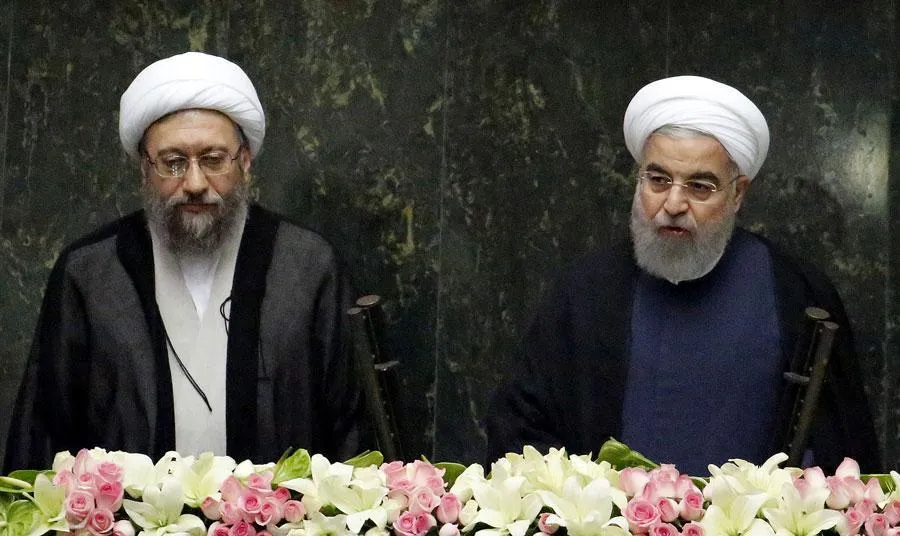
Iran's President Hassan Rouhani (r) delivers a speech next to Judiciary Chief Sadeq Larijani (l) during his swearing-in ceremony before parliament in Tehran, on August 5, 2017. ATTA KENARE/AFP/Getty Images
Iran
In His Second Inaugural Speech, Rouhani Attacks U.S. for Breach of JCPOA
Iranian President Hassan Rouhani was formally sworn in for his second term on August 5. His wide-ranging inauguration speech laid out the moderate Rouhani’s priorities for the coming term and emphasized Iran’s commitment to the multi-nation nuclear deal (JCPOA). Iran, he said, will not remain silent about Washington’s repeated violations of the accord. Lambasting President Donald Trump’s foreign policy, Rouhani quipped, “Today is the time for the mother of all negotiations, not the mother of all bombs”—an apparent reference to Trump’s use of the largest U.S. non-nuclear bomb in Afghanistan, a military strike that had little strategic value and huge collateral costs. Rouhani concluded the U.S.-focused portion of the speech with a clear swipe at Trump, saying, “We do not wish to engage with political novices. Those who want to tear up the nuclear deal should know that they will be ripping up their own political life by doing so, and the world won’t forget their noncompliance.”
EU’s Top Diplomat Attends Rouhani’s Inauguration, Reaffirms Commitment to JCPOA
Federica Mogherini, the European Union’s foreign policy chief, was one of the few non-Iranian politicians to attend President Hassan Rouhani’s second inauguration, a move that she later said signaled the EU’s commitment to the Iran nuclear deal (JCPOA). In an official statement issued after Mogherini’s appearance, the EU declared that her attendance “reiterated the EU’s unwavering commitment to the deal, recalling its historic significance, multilateral dimension and its importance for regional and global stability.” Many in Iran, including President Rouhani and Foreign Minister Javad Zarif, see the EU as the deal’s best steward, and hope that by deepening relations with it they can keep the deal from imploding.
Rouhani, in Second-Term Shake-Up, Cuts IRGC from Cabinet
In a break with precedent, Iranian President Hassan Rouhani proposed his second term cabinet on August 8 cutting the Iranian Revolutionary Guard Corps (IRGC) from control of the Defense Ministry for the first time in more than 25 years. The IRGC’s removal from the cabinet marks the largest staffing departure in Rouhani’s proposal, with major players like Javad Zarif staying on as foreign minister and Eshaq Jahangiri expected to remain as vice president.
Iran Backs Taliban in Afghanistan
A bombshell New York Times report on August 6 revealed that Iran, once an enemy of the Taliban, has been providing the Afghan group with covert support in its efforts to beat back the United States in Afghanistan. The aid, mostly in the form of commandos and training, comes as nations across the region—including Saudi Arabia and Pakistan—attempt to shape the future of Afghanistan in their favor. However, the report also alludes to the stress this gambit could put on shaky post-war Afghanistan, and the risks Iran assumes in aiding its former enemies.
Iran, Türkiye Sign Oil and Natural Gas Deal With Russia
Iran, Türkiye and Russia all signed on to an agreement that would have the three nations jointly invest and develop numerous projects inside Iran. The deal comes as Iran looks to make the most of a burgeoning international business that has been facilitated by lessening sanctions and increased good will. The deal reportedly will spur more than $4.2 billion in investment.
—David DePriest
Iraq
Shi’i Iraqi Clerics Advise Dismantling PMF
In an August 4 speech, Muqtada Al-Sadr, the popular Iraqi Shi’i cleric, politician and militia leader, called on Prime Minister Haider Al-Abadi to dismantle the Popular Mobilization Forces (PMF) and “integrate into the army the disciplined members.” Shi’i cleric Sheikh Fadil Al-Bidayr also called for the dissolution of the PMF, saying, “We always knew Iran would use this [call to arms when ISIS was conquering much of Iraq in 2014] to increase its own power in Iraq, but we had no other choice.” On August 5, Al-Abadi announced, “The Hashd Al-Shaabi [Arabic for PMF]…is for Iraq and will not be dissolved.” The following day, PMF security spokesman Youssel Al-Kelabi said, “Hashd Al-Shaabi is an official military organization affiliated with the government of Iraq. Like other government security agencies, they will continue their regular activities after the end of Da’ish.” He told Iran’s Islamic Revolutionary Guards Corps-affiliated Tasnim News Agency that the “dissolution of the Hashd Al-Shaabi is not possible under any circumstances,” and emphasized that U.S. troops were not needed in Iraq.
Iraq’s PMF Militia Blames U.S. for Attack
An August 7 attack on the Iran-backed Iraqi militia Kataib Sayyid Al-Shuhada, part of Iraq’s Popular Mobilization Forces, near the Syrian town of Al-Tanf on the Iraqi-Syrian border, killed 36 militia members and wounded 75, according to a militia spokesman. The militia released a statement saying, “We hold the American Army responsible for this act,” because the attack used smart rockets. Militia leader Abu Ala Welayi accused both the U.S. and ISIS of responsibility, adding that seven fighters in Iran’s Islamic Revolutionary Guards Corps had been killed. On August 8, the U.S.-led coalition in Syria and Iraq denied responsibility, maintaining it did not conduct airstrikes in the area at the time of the attack. ISIS claimed responsibility for the attack.
27 Men Receive Death Penalty for Camp Speicher Massacre
On August 8, an Iraqi court sentenced 27 men to death for their involvement in the ISIS massacre of approximately 1,700 mostly Shi’i soldiers in June 2014 at the former U.S. base camp Speicher, near Tikrit. The convicted men can now appeal the decision. Due to lack of evidence, 25 others were released. Last year 36 men were also sentenced to death for their roles in the massacre.
Iraq, Saudi Arabia Reopen Border Crossing
The Arar border crossing between Iraq and Saudi Arabia has been opened for the first time in 27 years. Tour buses carrying more than 1,000 Iraqi pilgrims performing hajj to Mecca were the first to cross. The two countries have also agreed to reopen air transportation links, although no date has been set. Relations between the countries have been poor since Iraq’s 1990 invasion of Kuwait, but have been improving in recent weeks.
Iraqi PMF Militia Warns KRG Over Independence Referendum
According to the Fars News Agency (affiliated with Iran’s Islamic Revolutionary Guards Corps), Adnan Faihan, head of the Iran-supported Popular Mobilization Forces militia Asa’ib Ahl Al-Haq, threatened Iraq’s Kurdistan Regional Government (KRG) over its upcoming independence referendum. Asa’ib Ahl Al-Haq will “confront” KRG President Masoud Barzani, he warned, if Barzani “tries to impose his will on disputed regions.” Baghdad will not “gift land to Masoud Barzani,” Faihan added. “The referendum that the Kurds talk about is about the Kurds, and the Arabs will not take part in it. We do not threaten Barzani, but warn him not to dare to mark the borders with blood. In such a situation, our hands will also not remain tied and we’ll confront him militarily.”
—Alex Shanahan















