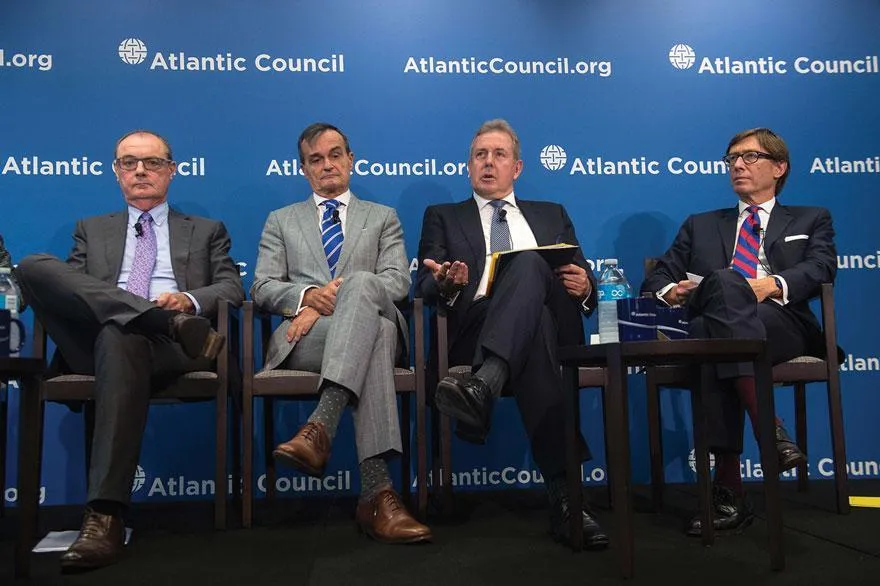
(L-r) European Union Ambassador to the U.S. David O'Sullivan, French Ambassador Gerard Araud, British Ambassador Kim Darroch and German Ambassador Peter Wittig. [Photo Nicholas Kamm/AFP/Getty Images]
The Atlantic Council hosted the two-part event, “How Europe and Iran’s Neighbors View the Nuclear Deal’s Future,” in Washington, DC on Sept. 25. [Neocon] Stuart E. Eizenstat, chairman of the Iran Advisory Board for the Atlantic Council’s Future of Iran Initiative, introduced the event by noting that despite Western concerns about Iran’s role in the region, there is no question as to Tehran’s compliance with the multilateral nuclear deal. “Iran has faithfully implemented the JCPOA, according to the IAEA,” he said. Going further, he cautioned that “Washington, rather than Iran, may be a bigger threat to the JCPOA.”
The first half of the event consisted of a panel of ambassadors from the EU, France, the UK, and Germany. Moderator Barbara Slavin, director of the Future of Iran Initiative, asked the ambassadors if their governments were prepared for President Donald Trump not recertifying the JCPOA.
Ambassador of the European Union to the U.S. David O’Sullivan began by emphasizing that the JCPOA has the full support of the EU and all 28 member-states, calling it a “groundbreaking non-proliferation agreement” that “if fully implemented by all sides, will make sure that Iran never obtains nuclear weapons.” O’Sullivan also stated that the agreement “belongs to the international community” and is “a public good for the international community.”
Ambassador Gérard Araud, the French ambassador to the U.S., reiterated O’Sullivan’s message, maintaining that France agreed with Trump that there are other issues with Iran that need to be addressed. However, he pointed out, the nuclear deal was “conducted in isolation from other issues, and it was done on purpose” because they “did not want to be dragged into a sort of quid pro quo between nuclear issues and other issues.” He described the idea of renegotiating the deal as a “non-starter.”
Britain’s ambassador to the U.S., Sir Kim Darroch, mentioned the recent meeting between Prime Minister Theresa May and Trump in New York, in which Trump laid out his issues with the deal. May and Trump agreed that there are issues in terms of such Iranian activities as “supporting Hezbollah, supporting the Houthis in Yemen, supporting Assad in Syria, and the importance of pushing back” against these activities. However, the UK feels that they “are more secure because of this deal.” Darroch went on to say that “as long as the Iranians continue to comply with [the JCPOA], in the view of the IAEA, we will continue to support it.”
Ambassador Peter Wittig, ambassador of Germany to the U.S., said that the nuclear deal is “worth preserving,” as it is a “plus for regional security; it’s a plus for global security” and is “the most intrusive, the most comprehensive, inspection verification regime in the world.” He went further by stating that those who “advocate to walk away” will have to consider the consequences of nullifying the deal. Iran could in turn resume enrichment activities, he warned, creating a “nuclear arms race in the region and beyond” that will “weaken the nuclear non-proliferation regime that we have established over the years.” Wittig also expressed concern that walking away from the agreement would signal to North Korea that diplomacy “is not reliable,” which would affect the credibility of the West.
The second panel consisted of Hussein Ibish, senior resident scholar at the Arab Gulf States Institute, Kadir Ustun, executive director at the SETA Foundation, and Hossien Mousavian, a Middle East security and nuclear policy specialist at the Woodrow Wilson School of Public and International Affairs and Iran’s former ambassador to Germany (1990-1997). The three scholars had a lively discussion on the impact of the nuclear deal on the region.
Ibish began by noting that the GCC has an “interesting set of diverse opinions on a range of topics.” In terms of the JCPOA, however, there is “a relative consensus that is not disrupted” by the break with Qatar. During the Obama administration, after “sufficient reassurances” the GCC collectively endorsed the JCPOA and decided to “do what they could with the reality, rather than take an Israeli position.” However, Ibish said, what the GCC is “most concerned about is the spread of Iranian influence and hegemony inside the Arab world,” beyond those areas where Shi’i Muslims are the majority. Overall, Ibish argued that a decertification of the JCPOA would be a “net negative” for the GCC, which instead wants the agreement to be “rigorously enforced.”
“Broadly,” Ustun stated, “Türkiye doesn’t quite like any new layer of instability to the region” and “elements of uncertainty and instability are a problem.” He emphasized that Türkiye has tried to find a middle ground between Iran and Saudi Arabia, citing the Qatar crisis and Syria. However, with the Kurdish referendum and the current state of Syria, the JCPOA is “not at the top of the agenda” for Türkiye. In Ustun’s opinion, “if the U.S. has confused policies, there will be more problems, not fewer” in the region.
Mousavian began by explaining his view of the state of affairs between Iran and the Arab world, listing Oman as a mediator, and Saudi Arabia and the UAE as “the only two hostile countries” neighboring Iran. In his opinion, the U.S. and Saudi Arabia are the “root causes of instability in the region.” Mousavian said there needs to be a discussion to find solutions to the “true problems” of the Middle East. Ibish and Mousavian strongly disagreed on the roles of Saudi Arabia and Iran in the region.
Despite some disagreement, the consensus of the day was that the JCPOA is working and that many actors, be they in Europe or the Middle East, would support its recertification. At the day’s conclusion, Slavin noted that “Trump wants to put his own stamp on Iran policy”—and we are all waiting to see what that might entail.
—Shannon Tawoos