















Washington Report on Middle East Affairs, August/September 2021, pp. 36-37
Special Report
By Mustafa Fetouri
AT THE G7 SUMMIT in the United Kingdom on June 13, President Joe Biden sought to reassure America’s allies by saying, “America is back.” The president wanted to send a message to allies and foes, alike, that the chaotic foreign policy of his predecessor is now a bad memory. The previous administration’s four years alienated allies while retreating from regional and international hotspots where the U.S. has important short-term interests and much more long-term strategic stakes to guard.
Libya is one such place where the U.S. appears to be coming back with a foreign policy shift to refocus on the country it helped destroy.
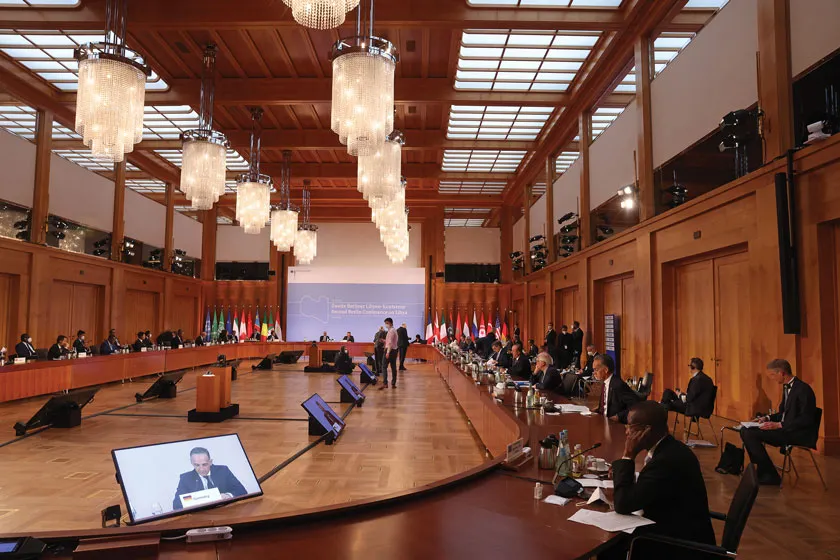
On June 23, Secretary of State Antony Blinken attended the second International Berlin Conference on Libya to review progress made since the first conference, which convened on Jan. 19, 2020. In preparation for the Berlin conference, on May 10, the State Department announced the appointment of the U.S. ambassador to Libya, Richard Norland, as special envoy to Libya to “lead U.S. diplomatic efforts to promote international support for a Libyan-led” political settlement process. On May 18, Norland, in his new role, accompanied Joey Hood, acting assistant under secretary of state for Near Eastern affairs, on a visit to Tripoli. This was the first such visit by a high-ranking U.S. diplomat to the broken country since the Obama years when Joe Biden was vice president.
This might not be a big shift from the previous Republican administration’s handling of Libya, but it represents a change in approach indicating a change of policy toward the North African country, for which the U.S. has a moral responsibility.
The former U.N. acting envoy to Libya, Stephanie Williams, believes the change in U.S. policy toward Libya started as early as late January, right after the Biden administration took over. In a recent interview Williams, a former U.S. chargé d’affaires to Libya, told the Washington Report, “the Biden administration is more serious about Libya.” She believes this shift goes beyond the tactical policy of seeking to counter Russia’s increased presence in oil-rich Libya.
Wagner Group, a Russian pseudo-private military company, has several thousand mercenaries in Libya, with whom Moscow always denies it has any links or control. They first started to trickle into the country in 2017 to offer technical assistance to General Khalifa Haftar, a Libya-U.S. dual citizen, who waged war in 2019 to topple the then U.N.-recognized Government of National Accord. Many believe Haftar got what amounted to a green light to launch an attack from former President Trump and his former national security adviser, John Bolton. Williams believes the go ahead from the U.S. came in two phone calls, first with Bolton followed by another call from the president himself in the spring of 2019. Williams said, “while we do not know what was said in the call, we know how it was interpreted.”
Since it was signed on Oct. 23, the country-wide ceasefire in Libya is still holding but thousands of foreign mercenaries and regular Turkish troops are still on the ground. Türkiye, which came to the rescue of the former government in Tripoli, brought in thousands of Syrian mercenaries and its own officers, eventually helping defeat Haftar’s army in June of last year.
It is not clear what Secretary Blinken said during the Berlin II conference about this particular issue. However, in a phone call to his Libyan counterpart, Najla Al-Mangoush on June 17, a few days before the Berlin meeting, he called for all foreign troops and mercenaries to leave Libya as soon as possible. This has been a consistent U.S. position for the last two years. However, Washington does not seem ready to take any action to make it happen.
While in Berlin, Blinken emphasized his government’s support for Libya as it prepares for elections planned for Dec. 24. However, elections are now in doubt after the U.N.-led talks in Geneva, Switzerland, ended on July 2 without agreement. The 75-strong Libyan Political Dialogue Forum was supposed to provide the constitutional base required for such elections. No new round of talks has been scheduled yet.
The departure of foreign forces is a requirement of the ceasefire document, and it is linked to the December elections—they should leave before election day. It was also one of the decisions made by the first Berlin conference last year and included in U.N. Security Council Resolution 2510, adopted on Feb. 12, 2020, which also called on all countries to stop interfering in Libya’s affairs. However, Resolution 2510 was never reinforced by any of the countries which committed to it at the Berlin I conference. Russia and Türkiye, in particular, are still sending military reinforcements to their respective local proxies.
After his summit with President Vladimir Putin on June 16 in Geneva, President Biden said they discussed Libya without providing any details. In the Berlin II conference, Secretary Blinken said nothing about the matter either.
The final statement of the Berlin II meeting, to which Secretary Blinken signed on, said that “all foreign forces and mercenaries need to be withdrawn from Libya.” However, Türkiye did not sign on to this particular demand. There is no indication that Blinken discussed the issue with his Turkish counterpart.
The important question is: what is the new Democratic administration going to do about this, as Libya’s election date gets closer? After all, President Biden was vice president when NATO unleashed its air power to help the rebels topple Libya’s former leader, Muammar Qaddafi, in 2011. While Biden was not in favor of military action in Libya, in 2016 his previous boss, President Barack Obama, appeared to regret his decision to take on Libya without any actual plans for what to do once Qaddafi was gone.
Since 2011, Libya has been in chaos and enduring wars displacing and killing thousands while thousands more fled abroad.
Lately, Libya has made significant progress, with its transitional Government of National Unity as well as united government institutions and a plan for presidential and legislative elections.
However, all such gains can be wiped out if, for instance, foreign powers keep meddling in the country’s affairs, particularly by offering military support for different factions that are benefitting from the current state of affairs inside Libya. Here the U.S. has a role to play. Stephanie Williams thinks that the U.S. “ability to convene” on the international stage will make other countries follow.
However, this has not yet been proven, at least in Libya’s case. Many Libyan observers ask the simple question: if the U.S. cannot stop its allies, like Abu Dhabi and Ankara, from meddling in Libya, how could it stop Russia?
The Biden administration’s reignited interest in Libya and its positive rhetoric will not do much good for the country unless concrete steps are taken to show the Libyans and others that the U.S. means business this time around.
Libya is strategically located and a gateway to both Europe and Africa making it a perfect choice for terror groups. ISIS, for example, used to control Sirte, on the Libyan coast, threatening its oil facilities as well as its neighbors. Williams thinks the presence of mercenaries is a “threat” to the entire region. The country’s fragile security has made it a preferred route for human traffickers, drug smugglers and illegal arms traders. The repercussions of what NATO, the U.S. included, did in Libya a decade earlier is still resonating in the area.
The instability in the entire African Sahel area, including Chad, Mali, Niger and Burkina Faso, is closely linked to Libya. This is a perpetually serious threat that needs concrete counter measures that go beyond attending international conferences and saying nice words. Whether the Biden administration is ready to face that challenge is not yet clear.
Mustafa Fetouri is a Libyan academic and freelance journalist. He is a recipient of the E.U.’s Freedom of the Press prize. He has written extensively for various media outlets on Libyan and MENA issues. He has published three books in Arabic. His email is [email protected] and Twitter: @MFetouri















