















Washington Report on Middle East Affairs, May 2024, pp. 48-49
Special Report
By Stasa Salacanin
VLADIMIR PUTIN’S December visit to Riyadh and Abu Dhabi may be interpreted as a message to Russia’s partners and rivals that Moscow remains an actor in the Middle East and that the West cannot completely isolate Russia, but it is unclear how much Russia can do in the region at the moment.
According to the former U.S. ambassador to Qatar, Patrick Theros, “Russia is seeking greater influence in the region,” although “it is hard to predict its success; if the Gaza campaign gets worse and the U.S. does nothing, Russia benefits. How much I cannot guess,” he told the English-language news website New Arab.
RUSSIA’S TIES WITH THE GULF STATES CORDIAL BUT LIMITED
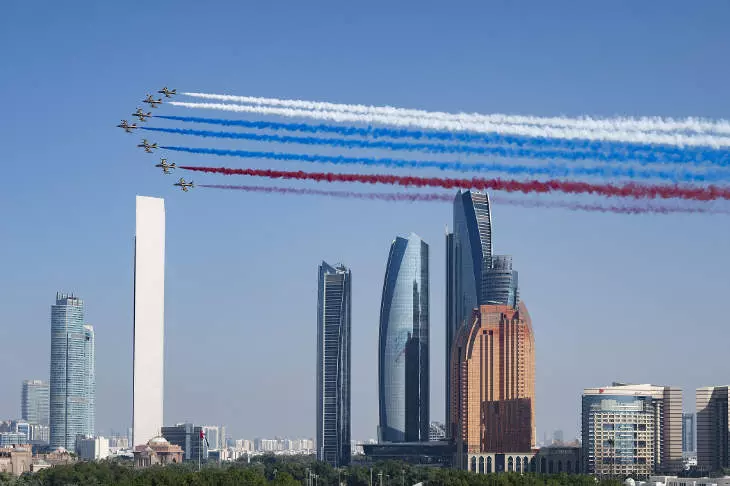
The Russian president was warmly welcomed by Arab leaders. Upon his arrival, a 21-gun salute greeted Putin while Emirati military jets trailed red, white and blue smoke—the colors of the Russian flag. Both the UAE and Saudi Arabia saw this as an opportunity not only to increase their international profile as power brokers and facilitators in potential peace negotiations, but also to send the message to the West that they do not wish to get dragged into a new cold war rivalry between the West and Russia or between China and the U.S. Instead the Gulf states prefer to pursue their quite autonomous and diversified foreign policy approach, which some analysts view as a strategy to gain greater concessions from the West. Both Russia and its Arab partners will try to exploit the anger of the entire Arab world against unconditional U.S. support of Israel in its Gaza crusade.
However, it is unclear how much Moscow can achieve and to what extent it may project its influence in the region, given its preoccupation with the war in Ukraine.
According to Mark Katz, a Middle East expert and professor of government and politics at George Mason University, as long as Russia is conducting a major war in Ukraine, “it does not seem likely that it will be able to expand its strategic alliances in the Middle East. Middle Eastern governments have certainly been willing to profit from Western sanctions against Russia by increasing their trade with it.” But those Middle Eastern governments that fear Iran can hardly count on Russian support against Tehran when Moscow is now so dependent on Iran for drones and other weapons.
As Russia’s standoff with the West will likely last for a very long time, Moscow is seemingly looking toward an ever closer partnership with Tehran, which will exceed current ad hoc military cooperation. Both sides have already discussed energy projects, a future increase in trade relations and large infrastructural projects while adjusting and integrating the Russian Mir payment system with the Iranian version. The countries have also reportedly reached a long-awaited deal on the purchase of Russian Su-35 fighter jets and a new generation attack helicopter Mi-28, that have been successfully used in Ukraine.
Many observers believe that one of the main motives for Putin’s December visit to the Gulf was to reassure and calm Arab partners about Russia’s increased cooperation with Iran.
RUSSIA MUST BE CAREFUL WHEN DEALING WITH ISRAEL-GAZA WAR
While Russia’s deepening ties with Iran will probably continue to create sporadic hurdles with Arabic states, a greater challenge will be the maintenance of complex ties with Israel, especially after Israel’s attack on Gaza and its condemnation of the Russian invasion of Ukraine. The Kremlin initially tried to achieve a balancing act in the Israel-Gaza crisis and took a guarded position, condemning the targeting of civilians and calling for a diplomatic solution to the crisis. But later on, Russia sharpened its rhetoric condemning the Israeli attack and sided with Palestinians, maintaining its ties with Hamas, which it sees as a legitimate Palestinian representative and not a terrorist organization.
On one occasion, for example, President Putin compared Israel’s besiegement of the Gaza Strip to the Nazi siege of Leningrad in 1941-1944, triggering anger among Israel’s leadership. Since the beginning of the conflict, Russia has been discrediting the U.S. for its unconditional support of Israel in an attempt to divert attention from the war in Ukraine to the ethnic cleansing and massacres in Gaza.
The U.S. standing in the Middle East is certainly under stress. However, Aron Lund, a fellow at Century International and the Middle East analyst at the Swedish Defense Research Agency, argues that Russia can hardly exploit that as a consequence of its invasion of Ukraine. He thinks that Moscow’s Middle East presence is now severely under-resourced and its diplomatic initiatives have little reach outside the usual circle of Russian partners and allies. “That doesn’t suffice for meaningful political action, especially as Russia’s leverage over Israel has suffered since 2022,” he told the Washington Report.
In Lund’s opinion, at this point Russian policy on Gaza seems to be mainly “about public posturing, encouraging anti-U.S. moves, and attempting opportunistically to insert itself in Gaza diplomacy through Security Council initiatives, vetoes, and so on.” Such a strategy may harm U.S. interests and solidify Russia’s ties with Iran-allied actors, at the expense of its ties to Israel, but that’s about all it does, Lund maintains.
However, both Russia and Israel have to be very cautious about not harming each other’s interests. In Syria there has been Russian-Israeli coordination, which has, on the other hand, caused some grievances in Tehran.
As Israel has reportedly stopped routinely warning Moscow of air strikes inside Syria, further frictions may have dire consequences for both sides as the ties between the two countries are at the lowest point in the last 30 years. While the war in Gaza is gradually destabilizing the region, powerful non-state actors, most of which are allies of Iran and Russia (such as the Popular Mobilization Forces in Iraq, Hezbollah in Lebanon, Houthis in Yemen, the Islamic Resistance in Iraq and Hamas) have already caused much damage to U.S. interests and Israel. Russia has also demonstrated its diplomatic leverage when Hamas released all captives with dual Israeli-Russian citizenship without a formal prisoner swap agreement, like the ones that have been mediated through Qatar and Egypt.
On the other hand, Moscow must be very careful about how to deal with the current crisis in Gaza and not to provoke Israel into providing advanced military technology to Ukraine.
Despite Russia’s very close relations with Arab countries, and despite Arab popular support for the Palestinians, Katz said that no Sunni Arab government has been willing to join Hamas in the fight against Israel or to trade their alliances with the U.S. for ones with Russia. “To be brutally frank: Sunni Arab governments fearing an American withdrawal from the Middle East understand that U.S. support for Israel keeps the U.S. in the region, and so U.S. support for Israel actually serves their interests,” he told the Washington Report.
The ongoing diplomatic efforts to end the war in Gaza may open another window of opportunity for some diplomatic offensive. Although Washington perceives itself as the main diplomatic player along with other regional actors such as Tehran, Cairo, Riyadh and Doha, and to a lesser extent to European allies, the U.S. reputation and infamous role of the blind supporter of Israel’s destruction of Gaza has cost Washington whatever little political credibility it still had.
In Lund’s opinion, Russia, China or both may seek to launch some initiative. “If they do, they may well draw a positive response from states in the region that are upset about Washington’s pro-Israel policies and want to stick it to Biden. But it’s unlikely to have a meaningful impact on the Gaza war.” Moreover, given the complexity of the Middle Eastern situation coupled with the growing leverage of Middle Eastern powers in an ongoing redistribution of global power, Russia will have to walk the tightrope and balance between the competing interests of other actors in the region, such as Türkiye and the Gulf states as well as the U.S., China and India, and try not to risk its assets.
Stasa Salacanin is a widely published author and analyst focusing on the Middle East and Europe. He produces in-depth analysis of the region’s most pertinent issues for regional and international publications including the Al Jazeera Center for Studies, Middle East Monitor, The New Arab, Gulf News, Al Bawaba, Qantara, Inside Arabia and many more.















