















Washington Report on Middle East Affairs, May 2026, pp. 26-27
Daily Life and Shattered Dreams in Gaza—Writers Share Their Stories
By Sahar Al-ijla
“WE WILL RETURN home someday, we won’t live here forever.” This is what my mother says to console us whenever we express our longing to return home—which we expected to do because the current “truce” (which turned out to be fake) promised we could.
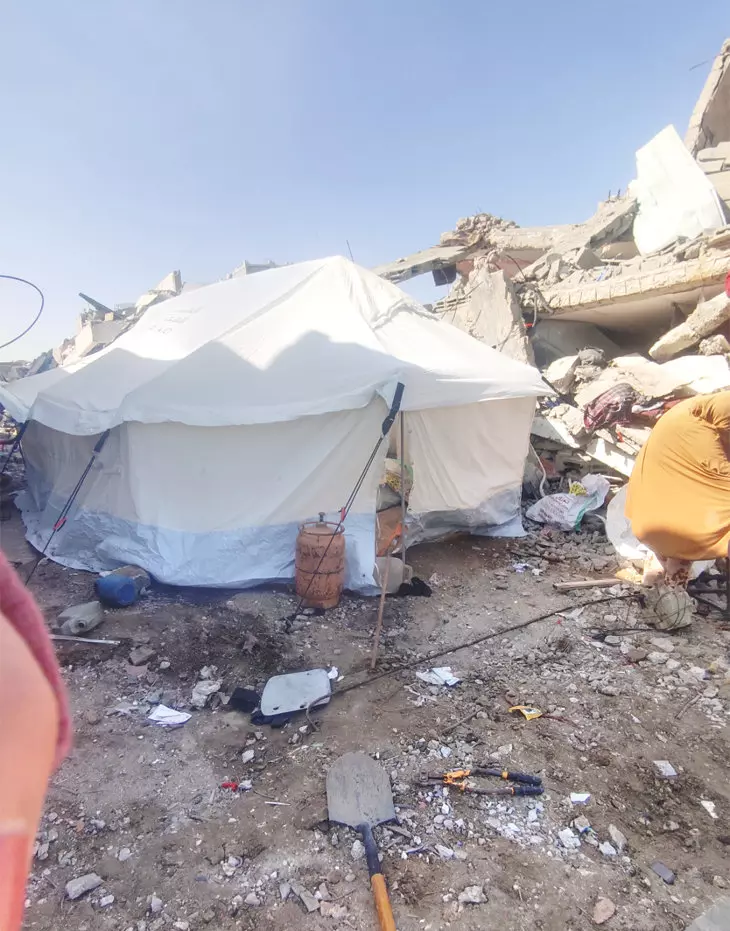
During the last truce, in February 2025, my eight-member family and I managed to return to the rubble of our home in al-Shuja’iyya, east of Gaza. Despite the obstacles, we were able to set up a tent among the piles of rubble and destroyed homes. Ours was one of them.
It was a life that lacked the basic conveniences and simple pleasures most people take for granted. Bringing food and water back to the tent took enormous effort; the massive destruction and danger of the Israel Occupation Forces (IOF) turned simple tasks into interminable nightmares. Nevertheless, it was something to call home and a routine to call life. And then we were displaced yet again.
Now, after another eight months of intense and aggressive escalation from the enemy, there is another temporary truce. We should be able to return home in the “second phase,” as the truce agreement states. But there is even less to return to now than there was in February.
Even if we do make it back, there is nothing left—not even a wall on which to lean or hang our belongings and photos or to shelter us from the dangerous gunfire and bombing. The area is completely destroyed and uninhabitable. As modest as it sounds to ask for a wall, it is an unavailable luxury in Gaza.
BLOCKING PEACE AND SECURITY
The IOF declared the eastern area of Gaza a danger zone and placed large yellow blocks to delineate a deadly threshold. These blocks represent the IOF’s colonial arrogance, as if this land were theirs to divide, inhabit and steal. This line renders our Gaza a peripheral reminder of everything they aim to erase. By making it yellow, they make their evil deeds seem shiny, cheerful, as natural as the sun. However, we Gazans call it a “red” area—as red as blood—because it is fatal: even approaching it could result in our deaths.
The army is not the only threat preventing us from returning. Palestinian militias have been cooperating with Israel, receiving protection in exchange for doing the enemy’s work. These armed gangs have positioned themselves in our beloved neighborhood, transforming it into their military camp.
The remains of partially destroyed buildings—houses, mosques and schools—are now used as headquarters for the militias, who are fully armed and have vehicles. The IOF supplies them with food, water, electricity—anything they need. Militiamen move around in groups, eliminating any perceived threat to them or the occupation. Gazans are invited to join them, to build stronger groups that assist the occupation army against local resistance forces. Those who approach them but refuse to join them are murdered either by IOF snipers and quadcopters or by the militia members.
DIVIDING LAND AND FAMILY
This fake truce hasn’t just deprived us from settling down in our homes; we are now separated from our family members. The majority of my family is still stuck in Deir al-Balah in the south, while the others have come back to Gaza City. My 21-year-old brother, Mohammed, left both his family and his fiancée to work as a wood seller in Gaza City. He collects wood from where the army withdrew and sells it. We call him daily but rarely see him because of the exorbitant cost of transportation between Gaza City and the south.
My sister Besan is also displaced elsewhere with her children and her husband’s family. We miss her, her children’s company and the joyful moments our weekly visits would bring. She lives in danger near the “yellow” line, where she hears constant gunfire and bombing while watching soldiers use their vehicles to further devastate the already ruined infrastructure. Despite the inherent danger, my sister is considered lucky to be living near her home.
Whenever we see a family packing their belongings onto a vehicle, preparing to go back home, it’s a frustrating reminder of all that we are deprived of; the oppression is tangible. It hurts to see others return while we must stay, especially when we all live in the same city. We all share the misery and suffering, but we don’t share the opportunities. My youngest brother, 11-year-old Ahmed, impatiently yells “how lucky they are!” when he sees Gazans climbing aboard their belongings and vehicles, returning home.
PHASE TWO?
The enemy and militias were supposed to withdraw and the area was to become safe for Gaza citizens to return, in the second phase of the fake truce. That has yet to take place. Violations are endless, and the IOF continues to expand the yellow area to the west.
We will return. But for now, short visits to reduce the longing for our home and memories must suffice, until the area becomes fit for habitation and a decent life. Until then, we are stuck in the south: displaced, homeless and anticipating our return home. There is nothing we can do now but pray, be patient, and tend the embers of hope.
Sahar Al-ijla graduated from Al-Azhar University with credentials as an English teacher. She enjoys writing and swimming. She is training with We Are Not Numbers, a project to amplify the voices of young Palestinian writers. Her mentor was Jodie Jones.















