Web Exclusive: Daily Life and Shattered Dreams in Gaza—Writers Share Their Stories
By Heleena Jawad Abdel-qader Darwish
WHEN THE CEASEFIRE BEGAN, we thought we were finally catching our breath. But what we didn’t know was that another enemy was waiting for us.
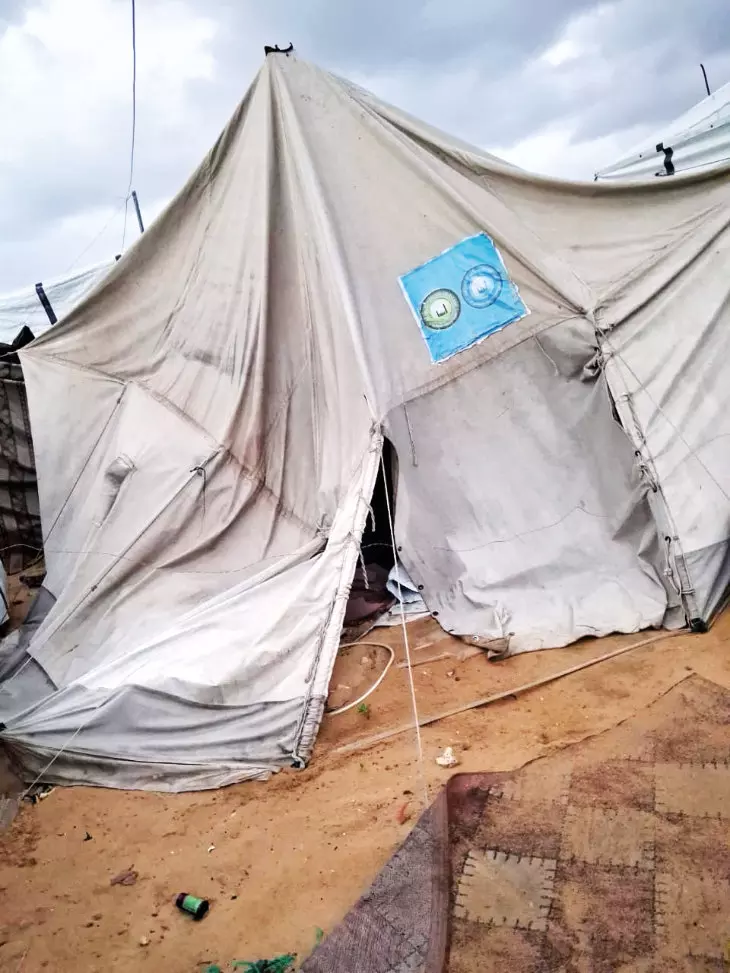
Winter arrived in Gaza in December with a violent storm. We woke in the middle of the night to a real nightmare: our tent had flooded. The pillows and blankets were completely soaked, and even the bags we used as temporary closets were drenched. Everything inside the tent was floating around us.
As I tried to process what was happening, I heard voices calling out to God, praying for mercy. We weren’t alone—every tent around us was under water. Water in every corner. The same devastating scenes repeated everywhere: women, children and the elderly sitting out in the street under the rain, shivering from the cold, their bedding soaked, their belongings scattered, confusion and crying filling the air. Our hearts felt heavier than the clouds above us.
We spent two full days trying to dry our things. The sun barely appeared and nothing truly dried. We didn’t leave our place—simply because we had nowhere else to go. The storm and the rain did to us exactly what the war had done. Both threatened our sense of safety.
Just one week later, another winter storm hit—stronger, with even heavier rain. Despite every precaution we took to prevent the flooding from happening again, nothing held. We did everything we could to protect our tent: tightened the ropes, reinforced the covers, added thicker plastic sheets, surrounded the tent with sandbags, and dug a trench to divert the water away. But none of it survived. The wind was stronger than us. The trench overflowed and water rushed in from every direction. The ground could no longer absorb anything. Within hours, the entire area turned into a swamp.
ALL OUR EFFORTS FAILED

The heavy rains also caused damaged buildings to collapse on top of the people sheltering inside them. With no money to buy tents and no space to pitch them, many families had no choice but to take refuge under the fragile roofs of their already weakened homes. This time, 11 people were killed when those buildings gave way.
After everything we have endured, we cannot survive a third winter season under these brutal conditions. We have already lived through two winters of displacement, surviving in tents that offer no protection from the cold or the rain, clinging to the hope that the ceasefire would bring some relief. Yes, the bombing slowed—but the relief never came.
We are still trapped in the same desperate situation we faced when the shelling was ongoing. Our bodies are exhausted from malnutrition and cold. We live under tents worn down by the sun, the wind, and the rain. I am a mother of two little girls. My eldest is not yet three years old, and my youngest has not even turned one. We live in a tent—this is all we have left after losing our home—and the cold gnaws at our bodies every night. We adults endure as much as we can. But how can two small children endure this freezing cold? How can such fragile bodies survive it?
We sleep on bedding placed directly on the ground. The cold seeps in from everywhere. We only have two blankets, which are not enough for these freezing nights. There is no source of heat—only exhausted bodies trying to warm their children. Sometimes my husband lights a small fire to provide a little warmth inside the tent.
Many people in Gaza are living in even worse conditions than we are. Most families who simply want a tent cannot afford one. A single tent can cost up to $500, and renting a small piece of land to set it up can cost another $500. Those who cannot pay end up living in the streets or in temporary shelters like schools and public spaces.
In al-Mawasi, in Khan Younis, the area is so overcrowded with tents that even the beach is filled with them. Most are nothing more than blankets tied around tiny spaces to create the illusion of privacy, and with every gust of wind, they tear apart. There are also children living directly on the streets, sleeping on the cold ground. Many of them lost their mothers and fathers during the war—perhaps they were the only survivors of families that were wiped out entirely. Some are now responsible for their mothers and siblings after losing their fathers, begging for help to support them. When you pass by them, you see them—sometimes silent, sometimes crying, sometimes simply searching for something to eat.
As a mother, every time I see a child alone on the cold ground, I imagine my own children in their place. Fear tightens around my heart.
Despite repeated promises of aid and reconstruction, the little that has entered Gaza has made no real difference on the ground. Although some organizations distributed tents and a limited number of blankets to displaced families in southern Gaza, this assistance meets only a small fraction of our needs after losing our homes and being left exposed under tents that offer no protection from the summer heat or the winter cold.
All of this is made worse by the absence of any collective effort to improve our living conditions as displaced people. Even basic materials—plastic sheets, nylon, ropes and wood to reinforce our tents—are painfully expensive. The vast majority of people in the south are concentrated in c, yet no serious measures were taken to strengthen shelters before the storms. So whenever heavy rain and strong winds hit, the tents collapse and all our repairs and attempts fail.

This means we are now facing a terrifying possibility: that life in a tent—one that can flood or tear apart at any moment—may become our long-term reality. It is an unbearable thought.
During the bombing, we lived in constant fear of death. The intensity of the war overshadowed everything else—the cold, the rain, the shaking tents above our heads. Now that the bombing has stopped, we are facing the full cruelty of this “new normal” in Gaza.
I fear this winter will be far worse for Gaza. With no real shelters and worsening weather day after day, we may witness the deaths of many children, elderly people and those with chronic illnesses. The first reported deaths from hypothermia were two infants, Rahaf Abu Jazar and Taym Al-Khawaja, in December 2025.
If the world is truly serious about ending the destruction in Gaza, it must act urgently and seriously to ensure we have the bare minimum for survival: food, shelter and medical care. But the truth that cannot be ignored is that shelter must come first. Without a roof to protect our children from the cold and rain, a child cannot eat, a patient cannot recover and a family cannot feel safe.
We are not asking for luxury. We are asking for the most basic form of protection: shelter—whether mobile homes or temporary housing units.
The ceasefire did not mean safety or stability for us. Despite what the headlines suggest, our suffering has not stopped.
Heleena Jawad Abdel-qader Darwish is an English language graduate who is passionate about learning and self-development. She ventured into the world of programming through an intensive web development training program at Code Academy, part of Gaza Sky Geeks, where she mastered essential technologies such as HTML, CSS and JavaScript. She also has a talent for creative storytelling. She is training with We Are Not Numbers. Her mentor was Gopal Dayaneni.