









Washington Report on Middle East Affairs, March/April 2025, p. 28
Daily Life and Shattered Dreams in Gaza—Young Writers Share Their Stories
By Nadera Mushtha
I CAN’T REMEMBER a single day when the sound of the drones wasn’t constant. Drones haunt us every day and follow us everywhere, like a shadow we can’t escape. These sinister machines have become a part of our daily lives, inflicting psychological torment and relentless headaches, and driving many to the edge of madness.
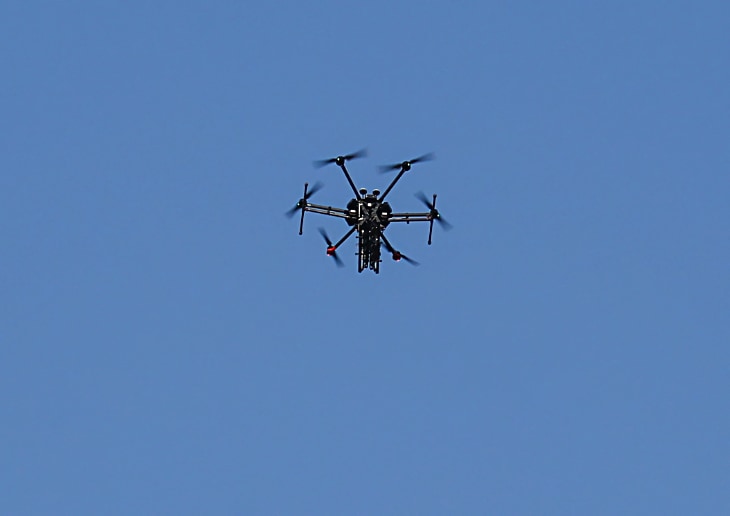
In Gaza, no matter where you are, you hear them, and when you look up at the sky, you see them, not one, but hundreds, endlessly circling above, casting invisible chains over us. In size, a drone falls somewhere between an airplane and a quadcopter. It has a shape like an eagle’s outstretched wings, gliding below the clouds.
The drones have been buzzing long before the war, even before I was born. I have been hearing their din for 21 years.
The sound is unbearable. It is the most piercing noise I have ever heard. It follows us day and night, whether we are working, shopping or attempting to sleep. It never stops.
Its noise is a weapon that doors, windows and walls are powerless to stop. The noise invades every space, slipping through the cracks, drilling into our ears and echoing in our minds.
My brain turns into a GPS, instinctively tracking the drones’ movements. When one hovers directly over my home, the sound grows louder, so loud that I feel it buzzing not just outside but inside my head and my bones.
When I sit down to write, the drone constructs an invisible wall between my mind and my pen. I feel that every sentence is a battle, each word a defiance of the drone monitoring me. Often I abandon my notebook in defeat, silenced by the relentless buzzing.
Studying is no easier. Lectures are drowned in the noise, the words of my teachers reduced to whispers I can’t comprehend. Even the simplest conversations with my friends are shattered by the ever-present hum. At times, I can’t hear their voices at all, only the endless, mechanical droning.
And when I (try to) go to sleep, its sound forces me to stay awake. The sound works its way into nightmares; by day it is an oppressive weapon.
Sometimes, when the sounds of the drones are far from our neighborhood, a sense of calm enters our bodies and our minds. We are surprised that we have a moment of peace in our lives.
And then, the quadcopter makes an appearance, a more intimate and terrifying predator. It hovers close to windows, its mechanical hum invading the night. It targets anyone, anywhere—women walking home, children playing in the streets, doctors and even the injured in hospitals.
I became acquainted with the quadcopter as a weapon for the first time during the war of 2021. I saw it from my window. At first I thought it was a photographer’s tool, operated by a Gazan capturing images. But I quickly learned that it is yet another weapon in the toolkit of the Israeli occupation.
When it hovers at our windows, especially at night, every one of my family members become silent. My young sisters become afraid of its sound, and sometimes they begin to cry.
Too many children, women and men have been killed by these machines, victims of an occupation that knows no red lines. Their laughter is silenced, their dreams dead, and their families left to grieve against a sky filled with endless buzzing.
This is the sound of our lives. The sound of drones, always above us, always reminding us that we are not free. Yet even in the suffocating noise, we cling to hope. Hope that one day, the sky will be ours again, quiet and filled only with the sound of the wind and the laughter of children flying their kites.
Nadera Mushtha is a writer and a poet from Gaza studying English language education at the Islamic University of Gaza. Since most schools in Gaza have been destroyed during the current war, she has been organizing English classes for children in her neighborhood. She is a writer with We Are Not Numbers.
(Advertisement)