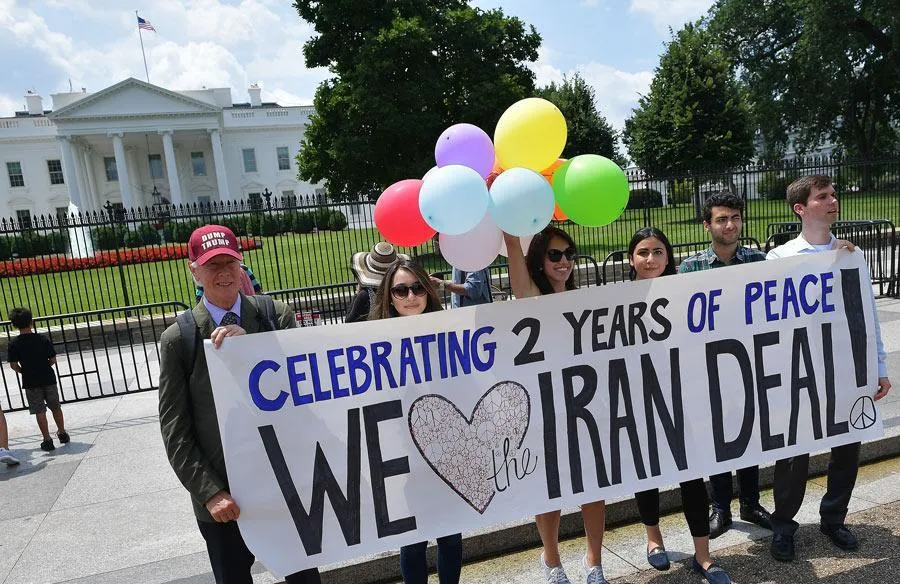
Activists take part in a rally to commemorate the nuclear deal with Iran in front of the White House, on July 14, 2017 in Washington, DC. MANDEL NGAN/AFP/Getty Images
Iran
Iran Air, Amid Rapid Expansion and Shake-Ups, Names First Woman CEO
Despite laws and precedent heavily disadvantaging women in the workplace, an increasing number of women in Iran have ascended to prominent positions. One such woman is Farzaneh Sharafbafi, who on July 12th was named the first female CEO of Iran Air. Sharafbafi, a 44-year-old former researcher with a Ph.D in aerospace, has a long history in aerospace, having taught for Amir Kabir University of Technology and Shahid Sattari University of Aeronautical Engineering for many years. As CEO, she will oversee Iran Air’s largest restructuring in decades, as fewer sanctions and increased travel interest buoy the airline. She will also help the airline navigate a multibillion dollar deal with Boeing, one that attracted interest earlier this year as many speculated whether the Trump administration would allow the deal to go through.
Saudi Arabian Missteps Strengthen Iran—FP op-ed
A high-profile opinion piece in Foreign Policy magazine warned that Saudi Arabia’s increasingly aggressive actions against Qatar, backed by notoriously mercurial U.S. President Donald Trump, have weakened its standing in the region and opened up a wide avenue for Iran to gain hegemony. The article goes on to note that continuing proxy wars in Syria and Yemen between Saudi Arabia and Iran have had the effect of lessening the Kingdom’s ostensible authority and dispelling the myth of their international support and military strength. A decline of Saudi Arabia could potentially destabilize the area, the magazine warns, splintering the region and elevating Iran to a singular regional power.
Iraq Begins Drilling Oil on Iran-Iraq Border
On July 9th, the Iraqi oil ministry announced that it had begun drilling in the Huwaiza field near the Iranian border. The field, which is said to contain nearly 1 billion barrels in reserves, is being drilled in a joint operation between the Iraqi-owned Maysan Oil Company and PetroChina, a Chinese oil company. The move is part of a broader push by the struggling Iraqi government to triple production as a means of shoring up their struggling economy. The Iranian government has not yet issued a statement regarding the new endeavor.
Iranian Oil Exports Surge 78 Percent Post-Sanctions
Amid eased sanctions and greater international outreach, Iran’s oil exports rose to 1.92 million barrels per day, an almost 78 percent increase over 2015. The figures were announced by OPEC in their Annual Statistical Bulletin, released July 10. Most of the exports were sent to Asia, but Iran’s efforts to improve relations with the West resulted in a quintupling of oil exports to Europe.
Iran Offers Tenders to Oil and Gas Companies, Hoping to Attract Investment
With surging domestic oil production and thawed relations lending it momentum, the Iranian government announced the first round of exploratory tenders—unconditional money offers—on offer to companies willing to drill in the country. The announcement last week that Total, one of the “big seven” largest oil companies in the world, entered the Iran oil market has many other companies mulling entry into the market. These tenders are meant to sweeten the pot and attract other big names like BP to the country, says NIOC Deputy Director Rahim Nematollahi.
Iranian Women Protest Restrictive Hijab Rules
A law mandating that women wear hijabs in public places has drawn ire from modern Iranian women, with a growing number of them openly defying the law, according to a new report by The Guardian. The increasingly moderate government, led by recently re-elected President Hassan Rouhani, has been more lenient on the enforcement of the law, with Rouhani saying in 2015 that “The police can’t do something and say I’m doing this because God said so. That’s not police business.” This lax enforcement, coupled with growing secular sentiment among young people in the country, has made calls for the repeal of the law louder than ever before. Many popular Iranian figures, such as Rouhani and lauded soccer player/coach Ali Karimi, have called for the end of laws that limit the rights and privileges of women.
Iran, Oman Announce Stronger Bilateral Ties
Amid rising tensions over Qatar and other regional conflicts, Iran and Oman announced that both countries have agreed to boost bilateral ties. “Iran and Oman have for years had fraternal relations and the best must be made of these good relations to reinforce them,” Iranian president Rouhani said July 12 after a meeting with Oman’s foreign minister. Both nations reaffirmed their commitment to Qatar, and both used the occasion to rail against Saudi Arabia, which Rouhani criticized as “threatening.”
—Compiled by David DePriest
Iraq
Iraqi Prime Minister Travels to Mosul to Celebrate ISIS Victory
Iraqi Prime Minister Haider al-Abadi arrived in Mosul on July 9 to congratulate troops on their victory over ISIS in the city. In a speech on July 10, he said, “I announce from here the end and the failure and the collapse of the terrorist state of falsehood and terrorism which the terrorist Da’ish announced from Mosul.” Iraq called a one-week holiday in celebration.
The nine-month-long battle has left many buildings damaged or destroyed, killed thousands of people and displaced about 900,000. ISIS also still controls other territory in western Iraq, including towns such as Hawija, Tal Afar and Oaim. According to the U.N., at least $1 billion is needed to rebuild Mosul’s basic infrastructure.
Fighting in Mosul went on into July 11 as airstrikes and mortar shells hit the few remaining ISIS holdouts. ISIS, also on July 11, released a statement that said it was attacking Iraqi forces in the al-Maydan area of Mosul’s Old City. ISIS claimed it killed and wounded many Iraqi soldiers and captured weapons and ammunition.
Iraqi forces are still clearing out ISIS fighters. “We still live in an atmosphere of war despite the victory announcement two days ago,” one Mosul resident said. Attacks by ground forces and airstrikes continue.
ISIS Launches Diversionary Attacks
On July 6, ISIS launched a diversionary attack against the town of Imam Gharbi 44 miles south of Mosul. Due to the attack, the International Organization for Migration had to suspend relief operations at two locations that house almost 80,000 people just north of Imam Gharbi. By July 11, ISIS had captured more than 75 percent of the town. Reinforcements came to Imam Gharbi on July 11. The same day, Iraqi troops resisted an ISIS attack on the village of al-Jaran. ISIS also attacked a border guard convoy in Anbar province that killed two soldiers and wounded four.
Amnesty International Report Documents West Mosul Violence
A report by Amnesty International on July 9 describes how ISIS forcibly moved civilians into battle zones to use them as human shields. It also charges that “Iraqi and coalition forces failed to take adequate measures to protect civilians, instead subjecting them to a terrifying barrage of fire from weapons that should never be used in densely populated civilian areas.” ISIS summarily executed hundreds, if not thousands, of people trying to escape the city and hung their bodies in public places, the report states. It documents 45 attacks by Iraqi/coalition forces that killed at least 426 civilians and injured more than 100. The report covers the time from January 2017 to mid-May 2017. It also notes that the 5,805 Iraqi/coalition-caused civilian deaths in west Mosul reported by Airwars is probably an understatement and the real number might never be known. Amnesty International accuses both Iraqi/coalition forces and ISIS of violating international humanitarian law and possibly committing war crimes due to civilian deaths in Mosul.
Lt. Gen. Stephen Townsend, the top U.S. commander in Iraq, on July 11 denied that the coalition violated international law. “I reject any notion that coalition fires were in any way imprecise, unlawful or excessively targeted civilians. I would challenge the people from Amnesty International or anyone else out there who makes these charges to first research their facts and make sure they’re speaking from a position of authority,” he said.
—Compiled by Alex Shanahan