Washington Report on Middle East Affairs, January/February 2023, pp. 32-33
Special Report
By Sohrab Ahmari
WHEN I WAS TURNING 8 or 9, my parents let me pick the restaurant we’d dine at to celebrate my birthday with a few friends. I picked an Indian restaurant not too far from our house in Tehran, more because I was intrigued by the idea of this spicy exotic cuisine than because I yearned for the thing itself. Seemingly playing to such ethnic curiosity, the owners of the restaurant had cranked the tacky-Indian-décor factor to eleven. No matter where you looked, your eyes ended up resting on some tapestry featuring an ornamented elephant fit for a Mughal prince or a statuette of Shiva the god destroyer.
The place was secluded when we arrived, the lighting was dim, and it felt so private that the dining area might as well have been an extension of our own living room (that is, if we lived in a house that could have doubled as a set for “Indiana Jones: The Temple of Doom”). The sense of secluded comfort must have made an especially strong impression on my mother, who did something unspeakable in the Islamic Republic of Iran as we sat down: she took off her headscarf and laid it on the back of her chair.
I won’t soon forget the reactions of our friends and of the waiter hovering in the background—or the mix of bafflement, fear and excitement that overcame me. All of us might as well have witnessed one of those Shiva statuettes coming to life to announce the end of the age in some inscrutable tongue and otherworldly voice. No one said a word, but the looks of shock alerted my mother that something was amiss with her appearance. You don’t do that in Iran, all said, silently. Think of the morality police! After another beat, she raced to bring herself into conformity with the law of the land. The torn fabric of everyday reality reconstituted itself, and soon we, my mother and the waiter included, were laughing about the incident.
Now, nearly three decades later, that fabric is coming apart on a much greater—indeed, national—scale. When it finally does reconstitute itself, the country won’t be the same.
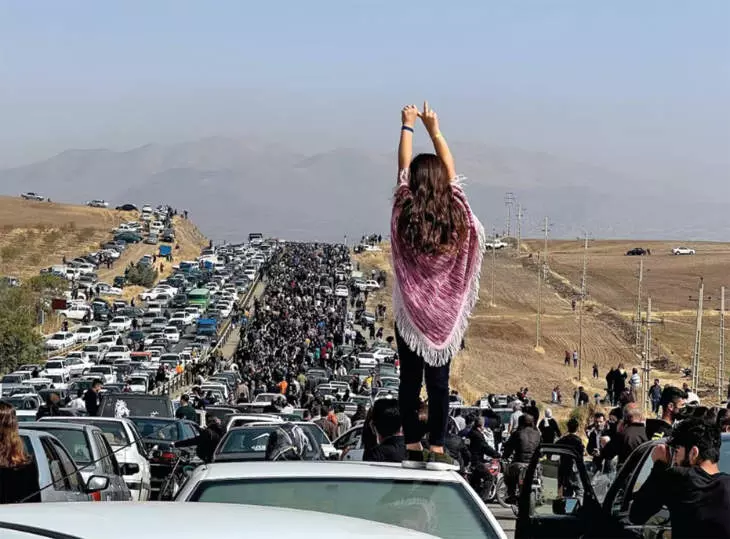
In response to the death in police custody of 22-year-old Mahsa Zina Amini last September (which set off waves of protest that continue to this writing), Iran’s attorney general, Mohammad Jafar Montazeri, said in early December that the morality police, known as the gasht-e-irshad, had been disbanded. He added that the government is reconsidering the compulsory hijab rules that have pestered more secular-minded Iranian women, like my mother and my late maternal grandmother, since the revolutionary regime’s beginnings. Although it is unclear whether Montazeri’s statement represents a real shift in policy, it is significant that his off-the-cuff remarks were memorialized by state-run media—though other state organs have notably contradicted him.
Whether the hijab rule has been abrogated, and whether the morality police have been formally abolished, the old order is de facto kaput. As the nationalist vlogger Omid Dana—a far more reliable Iran watcher than the likes of the BBC and Voice of America, though sadly his content is exclusively in Persian—has reported, easily 50 percent of women in large cities are no longer covering up. The figures, Dana says, are likely higher in the more affluent neighborhoods. Enforcement is no more. Filmmakers dealing with domestic scenes are reportedly doing double takes of each scene, one with female actresses in hijab and the other without it, in the expectation that they will soon be permitted to show uncovered women on state TV.
What was once unthinkable and unsayable in the Islamic Republic has become quotidian. On state TV, for example, a cleric named Reza Gholami explained why Iran has been exploding with social turmoil:
“In years past, we committed mistakes in governance, and these mistakes have increased of late. One reason has to do with the growing complexity and delicacy of the governing arena. Governance in today’s global conditions has nothing to do with governance 30, 40 years ago...In today’s atmosphere, we have to accept that the security forces have done wrong. For starters, the security forces shouldn’t have been in the business of enforcing hijab in the first place, and this person [Mahsa Amini, the woman whose death at the hands of the morality police sparked weeks of protests] wasn’t even wearing bad hijab to such a degree that it required her detention...And in recent months, as a result of a long process, we confront a vast social polarization, a polarization that is now accelerating, and elements within the Islamic leadership and system caused this polarization to widen.”
These are stunning words. Here you have a member of the ruling clerics taking to state media to blame not the United States, nor Israel, nor Britain, but the regime’s own mismanagement of popular demands. And they are popular. Last month Mostafa Rostami, Supreme Leader Ali Khamenei’s representative to the universities, conceded that 55 percent of the population, or roughly 44 million Iranians, approved of the anti-hijab protests, according to the regime’s own internal surveys.
What comes next remains unclear. There are those in the West who think these transformations prefigure a regime-change scenario. I used to be among their ranks. But the Middle East’s experience over the past two decades has taught me to be wary of turmoil.
Fact is, the regime enjoys a hard core of supporters who fervently believe its message and materially benefit from it. I would put the figure at about 20 million—20 million people who have given life and limb for the Islamic order founded by the Ayatollah Khomeini and who happen to control the most powerful and prestigious elements of the security forces. Iran, moreover, is a multinational state riven by ethnic and sectarian fault lines. No one should welcome its violent dissolution amid internal turmoil, because a civil-war scenario in Iran would make Syria look benign.
The saner route, as I argued Commentary in 2018 and the New York Post a year later, is a managed transition involving figures inside the security forces, men who realize that Khomeini’s brand of Islamism has run its course, that an Iran governed along more nationalist lines can deliver the normalcy—which is not necessarily liberal democracy—for which the people are so desperate. At stake is nothing less than the stability and territorial integrity of one of the most strategically significant nations on earth.
Sohrab Ahmari is a founder and editor of Compact magazine, a contributing editor of The American Conservative, and a visiting fellow of the Veritas Center for Ethics in Public Life at Franciscan University. First published by The American Conservative on Dec 6, 2022. Reprinted with permission.
(Advertisement)