















Washington Report on Middle East Affairs, January/February 2021, pp. 35-37
Three Views
The Pride of Israel: Assassinations
By Gideon Levy
ALONGSIDE DRIP IRRIGATION and cherry tomatoes, there are few areas in which Israel takes more pride than what it calls “targeted killings,” which are in fact acts of murder by the state. With the exception of the United States, Saudi Arabia and Russia, there are few states that murder their adversaries or their enemies, certainly not in the large numbers that Israel does.
Since 2000, Israeli forces have murdered about 70 Palestinians, some of whom were clearly political activists and not militants, in planned, targeted killings.
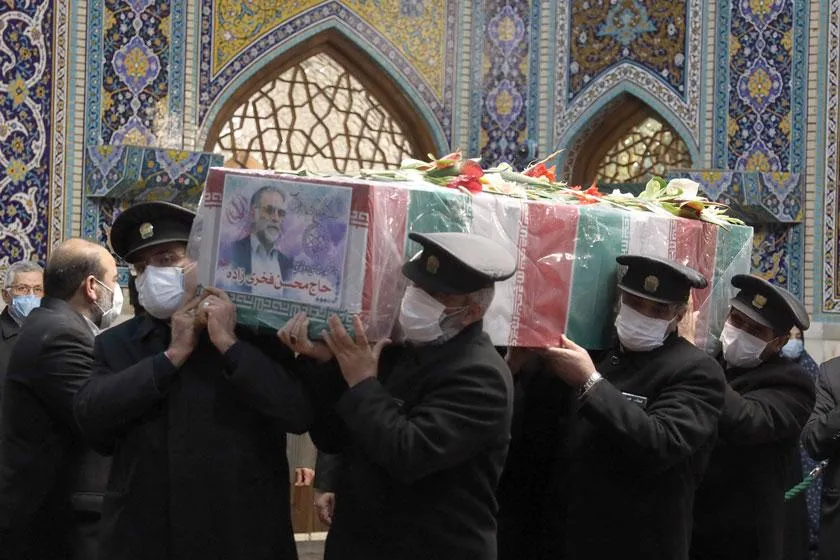
The assassination on Friday, Nov. 27 of Prof. Mohsen Fakhrizadeh on Khomeini Boulevard on the outskirts of Tehran was also not the first assassination of an Iranian nuclear scientist. Before him about a dozen scientists were murdered—most of them, if not all, presumably by Israel. How did Prime Minister Binyamin Netanyahu put it Friday, with a sly, knowing smile? “It’s been a week of achievements.”
These “achievements” indeed fire the imagination. On Channel 12’s Friday night news program, a panel of giants debated whether these were “gunslingers,” as the military analyst argued, or a powerful explosive device, as the Arab affairs analyst claimed. There was only one issue that was not raised in this, or indeed in any other forum: whether these targeted killings are legitimate. The very question is considered a heresy, treason. Was it not legitimate to take out Dr. Thabet Thabet, a dentist and the head of Fatah in Tul Karm, in December 2000? Was it not permitted to murder Khalil al-Wazir (known as Abu Jihad) in his bed in front of his wife and children in Tunis in 1988? Don’t make Israel’s security cult laugh. Of course it was allowed. To Israel, everything is allowed. The Palestinians who planned the assassination of Tourism Minister Rehavam Ze’evi were sentenced to life in prison. The murderers of Abu Jihad became cabinet ministers and heroes. Ze’evi spilled more innocent blood than Abu Jihad ever did.
The question of the purpose and the usefulness of the assassinations is also barely discussed. The fact that the operations are so James Bondian and that the glorious Mossad and Shin Bet security service are behind them is enough to silence all such talk. If an operation is as successful as Friday’s, it’s a sign that it’s permitted and also worthwhile. All the other questions are simply subversive.
And yet, it must be asked: What would have happened had foreign agents wiped out Profs. Israel Dostrovsky and Ernst David Bergmann, Shalhevet Freier or Shaul Horev, the Israeli historic counterparts of Fakhrizadeh? What would Israel have said then? And how would the state have responded? Would it have stopped its nuclear program? Would it not have launched a campaign of revenge all over the world?
Amos Yadlin, a former Israel Air Force general who is the executive director of Tel Aviv University’s Institute for National Security Studies, tweeted over the weekend about Fakhrizadeh: “The man dealt with all aspects of Iran’s illegitimate nuclear activities.” A question: Is there such a thing as Israel’s “illegitimate nuclear activities”? If so, does its planner also deserve to be killed? If not, doesn’t this say that Israel is permitted to do anything, including things that are not permitted to any other state?
Communist Bulgaria assassinated people with poisoned umbrellas. Saudi Crown Prince Mohammed bin Salman, Netanyahu’s newest interlocutor, assassinated a man by dismemberment. The world views both as despicable actions by state agents. Israel is allowed. Israel gets a free pass. We made jokes about Iran’s “Black Friday.” Israel is allowed to rub out the “father of Iran’s nuclear program”—of course that’s what he was, just as every assassinated member of Hamas is a “senior figure” in the organization—just as it is permitted to use types of weapons and ammunition that are prohibited to other states.
The question remains whether Friday’s murder will stop the Iranian nuclear program or, perhaps, accelerate it instead. Will it lead to a harsh reprisal attack? On this, the experts all actually agreed: Iran will certainly take revenge. And what then? Even then, will it have been worthwhile? Of course. After all, once again we showed them what we know how to do best, with the exception of drip irrigation and cherry tomatoes. To kill and to destroy.
Gideon Levy is an Israeli journalist and author. This article was first published in Haaretz, Sept. 2, 2020. © Haaretz. Reprinted with permission.
Tail Wags the Dog, and Makes Biden A Chump
By James North and Philip Weiss
THE PUBLIC does not know yet how it came to pass that the top Iranian nuclear scientist was assassinated outside Tehran Nov. 27, but experts say that Israel did it.
What we do know is that Israel has a hidden motive: It wants to destroy any chance of Joe Biden re-entering the nuclear deal by envenoming relations between the U.S. and Iran and empowering hardliners in Iran.
Why would an Israeli attack envenom U.S.-Iran relations? Because Israel would only undertake such an attack with the O.K. of the Trump administration. (“While it’s highly unlikely that Israel would have carried out the assassination without a green light from the Trump administration, a more direct U.S. role cannot be entirely discounted,” according to Trita Parsi at Responsible Statecraft.)
Now does anyone really think this was Donald Trump’s idea? No: Israel is acting to its own devilish ends, and the U.S. government is signing off. Binyamin Netanyahu has directly told Joe Biden he must not re-enter the Iran deal.
Which goes to the essential tragic point here: “If an extraterrestrial arrived and looked at the U.S.-Israel relationship he/she/it would be right to think the U.S. is a client state of Israel.”
The tail is once again wagging the dog.
Because what is the likelihood that Biden will be able to exercise independent foreign policy in the wake of the murder of Mohsen Fakhrizadeh? That likelihood decreases by the moment. The president-elect’s hands are being tied by rogue foreign policy-makers on both sides of the Atlantic. He will have that much more work to do to try to restore the Iran deal.
This tagteam has been at it before. As Scott Roth writes:
Israel is trying to ignite a war while it still can. Israel likes these transition periods. Twelve years ago they started Cast Lead because they weren’t sure how an Obama administration would feel about bombing Gaza. And Obama let it go and we see how that went. Will Biden dial this back? I have low confidence that he will.
The other tragic thing about this attack is that everyone knows all this, but it’s unsayable in Washington. Yes, Trita Parsi says some of it at Responsible Statecraft:
Either way, the assassination (and other likely future attacks) will likely harden Iran’s position and complicate—if not ultimately cripple—the Biden team’s attempts to revive diplomacy. That serves Netanyahu’s interest as well.
Repeat that point: Israel is crippling Biden’s foreign policy.
But the New York Times isn’t going there, and neither is the Washington Post. To his credit, last night on the PBS News Hour, Nick Schifrin lifted the carpet a bit. The attack might only “create an incentive for Iran to pursue a nuclear program,” he said, then ventured, “Biden and his team say they want to re-enter the Iran nuclear deal—what do you make of the timing of this attack, just 54 days before inauguration?”
But Schifrin’s interviewee was a tool, a former CIA officer named Norman Roule, who said:
I think, for the Biden administration, looking at this deal, they’re going to have to respect the security concerns of regional actors to a greater extent to avoid other incidents such as this upsetting nuclear negotiations.
Translation: the U.S. is Israel’s client state so forget about it. Let their “security concerns” drive policy. Mother o God.
Our press and the Beltway seems to accept his crap. As Joe Cirincione of Ploughshares writes:
I am very disappointed at many of my Washington colleagues who take a “on the one hand…” approach to Israel’s assassination of an Iranian scientist. Are they that afraid of being on the “wrong side”? Why do they fear condemning terrorism when done by Israel?
Good question. Why? Because Israel is ensconced in U.S. hearts and minds thanks to the Israel lobby. The New York Times did quote that moral beacon, former CIA chief John Brennan, tweeting:
[T]he killing was a “criminal act & highly reckless” and… it risked “lethal retaliation & a new round of regional conflict.”
It’s pitiable really. The Iran deal was the signature foreign policy achievement of the Obama administration. President Obama spent huge amounts of political capital on it, gaining liberal Zionist support for the deal so that he could defy the center-right lobby and Netanyahu. Then Trump came in and trashed the deal to please his biggest donor, Netanyahu’s friend Sheldon Adelson. And now Trump and Netanyahu are murdering scientists to “sow the earth with salt between now and Jan 20, 2021,” and everyone just shrugs...
James North is editor-at-large and Philip Weiss is founder and senior editor of Mondoweiss. Reprinted from Mondoweiss with permission.
Has Bibi Boxed Biden in on Iran?
By Patrick J. Buchanan
IF ISRAEL, as is universally believed and has not been denied, was behind the assassination of Iran’s leading nuclear scientist, questions arise:
Why would the Israelis kill him? And why would they do it now?
The scientist, Mohsen Fakhrizadeh, it is conceded, was a leader in Iran’s nuclear bomb program, but that program was disbanded in 2003. Under George W. Bush, in 2007, all 17 U.S. intelligence agencies declared with “high confidence” that Iran no longer had a bomb program. Four years later, the same intel agencies affirmed that finding. Since 2015, Iran’s nuclear facilities, under the Iran nuclear deal, have been subject to U.N. surveillance and inspections. And Iran has neither produced plutonium nor enriched uranium to the 90 percent level needed for a bomb.
Israel claims Iran never stopped working on a bomb, but U.S. intel agencies and U.N. nuclear inspectors have agreed that the military nuclear program that Fakhrizadeh oversaw was ended in 2003.
So, again, why would Prime Minister Bibi Netanyahu authorize Mossad to send an assassination team to Iran to kill the nuclear scientist? And why now?
If Iran is actually running a secret program to build a bomb in violation of the nuclear deal, why not identify the site of the violation, demand that U.N. inspectors visit, expose Iranian duplicity to the world, and kill the deal?
Why kill the scientist? From Netanyahu’s standpoint, there are, however, many motives to make the call to kill Fakhrizadeh.
To humiliate the Iranian regime. To demonstrate Mossad’s capacity to kill Israel’s enemies with impunity. To send a message to others working in Iran’s nuclear program that the regime’s security forces cannot protect them.
To Sunni and Gulf Arabs who see Iran as a sectarian and strategic rival and adversary, Israel’s ability to punish Iran and its regional militias with repeated, unanswered strikes makes Israel a far more desirable ally and partner than ever before.
But with this strike, Bibi was also sending a message to Joe Biden, who is seven weeks away from assuming the presidency.
What is Bibi’s message?
Mr. President-elect: This Mossad operation should tell you how seriously we view Iran’s determination to build a nuclear bomb, and how existential a threat that would be for us. And we intend to deal with that threat sooner rather than later.
And if, on taking office, you try to rejoin the Iran nuclear deal and lift U.S. sanctions in return for Iran’s full compliance with the terms of that deal, then we will not be restricted in the actions we take to prevent that from happening.
As President Trump put America first, we put Israel first, and Iran tops the list of threats we intend to face—preferably with you, but if necessary, alone.
From Bibi’s standpoint, the killing of Iran’s top nuclear scientist seems to be a win-win-win proposition. Bibi’s personal scandals are eclipsed and put on the back burner. He is seen by Israelis as a man of action and a decisive protector of the nation against its greatest threat.
Should Iran answer the assassination with a counterstrike, that could lead to Israeli retaliation, escalation and war. This could turn Bibi into a wartime prime minister like Winston Churchill and fulfill his dream of having America bring its full air, naval and missile power to deliver a crushing blow to the Iranian military and the Ayatollah’s regime.
However, the assassination of Fakhrizadeh and Iran’s resolve to retaliate complicates—if it does not close—Biden’s path toward rejoining the nuclear deal and reconciling with Iran.
If the killing ignites a war, Tehran knows there is a real possibility that America would align with Israel, as Donald Trump detests the Iranian regime as much as Netanyahu does.
And if the “moderates” in Tehran fail to maintain the national honor by retaliating against Israel, that could result in a hardline regime winning in this year’s elections. A return of the hardliners could mean a total collapse of the Iran nuclear deal and a new cold war that could eventually end in the hot war Middle East hawks—in Iran, Israel and the USA—have long desired.
As Trump showed with the assassination of Gen. Qassim Soleimani in his car coming out of Baghdad airport, he does not recoil from direct action against perceived enemies.
Last week, the U.S. flew two B-52s out of Minot, North Dakota, to the Middle East. The USS Nimitz carrier group began moving out of the Indian Ocean toward the Persian Gulf.
Four days before the hit on the Iranian scientist, Netanyahu reportedly met secretly in a Red Sea port city with Saudi Crown Prince Mohammed bin Salman and Secretary of State Mike Pompeo.
Was Pompeo told what the Israelis were about to do? Did the U.S. know of, approve of, or not object to the attack? Do Americans want this war that seems closer today?
Patrick J. Buchanan is the author of Nixon’s White House Wars: The Battles That Made and Broke a President and Divided America Forever. Printed with permission of Creators website at www.creators.com.















