















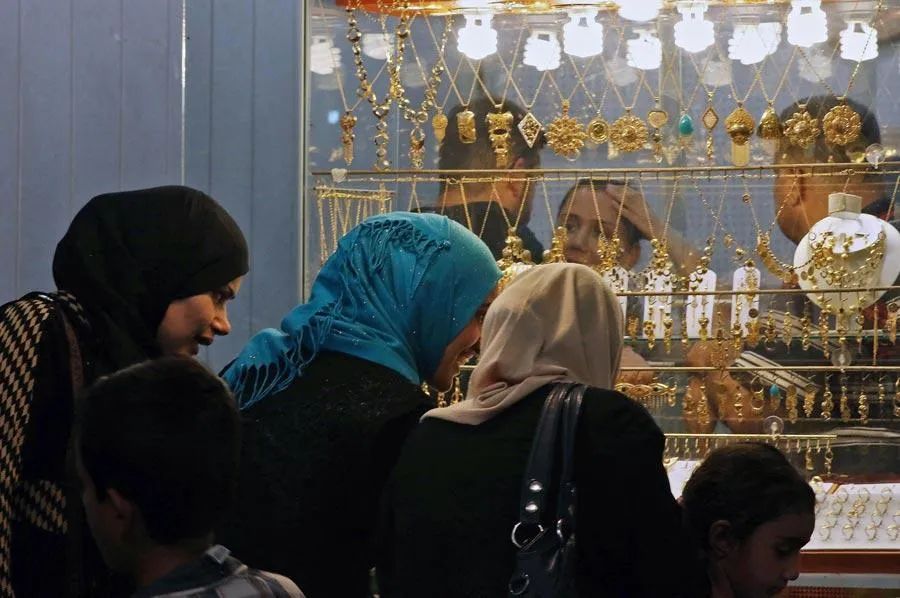
Iraqi women look at gold jewelry displayed at a market in east Mosul on July 28, 2017. SAFIN HAMED/AFP/Getty Images
Iraq
Foreign ISIS Fighters Likely to Remain in Iraq and Syria
On July 21, Nicholas Rasmussen, director of the U.S. National Counter Terrorism Center, said that foreign ISIS fighters in Iraq and Syria are likely to stay and fight in Iraq and Syria rather than return home. “Many if not most of the foreign fighters who made their way to the conflict zone will end up staying, fighting, and potentially dying in order to maintain the caliphate,” he said. Previous intelligence assessments suggested that many foreign fighters would return to their home countries and pose threats there. Rasmussen also said he has not seen any evidence that ISIS leader Abu Bakr Al-Baghdadi is dead. A U.S. intelligence official assessed that there are fewer than 15,000 ISIS fighters still in Iraq and Syria.
U.S. Judge Prevents Deportation of 1,444 Iraqis
On July 24, U.S. District Judge Mark Goldsmith prevented the deportation of 1,444 Iraqis from the U.S. The American Civil Liberties Union (ACLU) argued the Iraqis would be persecuted on the grounds of their religion and ethnicity if they were sent back to Iraq. The decision allows the Iraqis to challenge their deportation in federal courts and effectively means no Iraqis can be deported for several months. In his decision, Goldsmith prevented the expiration of his previous ruling that expanded the deportation halt from 114 Iraqis in Detroit, Michigan to more than 1,400 across the country. Of those 1,444 Iraqis, 199 were arrested in June during a nationwide immigration sweep. The ACLU sued the federal government on June 15 to stop the deportations. Many of those arrested had standing deportation orders and had been convicted of serious crimes.
Iraqi Forces Control Entire City of Mosul
On July 24, Pentagon spokesman Navy Capt. Jeff Davis announced that Iraqi forces were in control of the entire city of Mosul. Iraqi troops are, however, still clearing caves and tunnels in the Old City, tracking down any remaining ISIS fighters, and clearing explosives left behind by ISIS. “There’s only been one coalition strike in Mosul in the last week and a single-digit number of direct-fire engagements in Mosul in the last week,” Davis said. “These are indicators of the improved security and stability situation there.”
ISIS Was Close to Having Key Ingredient for Dirty Bomb in Mosul
While in control of Mosul, ISIS had Cobalt-60 within reach at occupied Mosul University. Cobalt-60 is the main ingredient needed to make a so-called dirty bomb. The two storage containers holding Cobalt-60 remained undisturbed when coalition forces found them in June, however, raising the possibility that ISIS could not figure out how to get inside the containers to retrieve the Cobalt-60 without being exposed to fatal radiation levels.
Iraqi Vice President Wants More Cooperation With Russia
During his July 25 visit to Russia, current Iraqi Vice President and former Prime Minister Nouri Al-Maliki stated that, after 14 years of U.S. military intervention in Iraq, he wants Iraq to have closer ties to Russia. “Historically, Russia has close relations with Iraq,” he noted. “That is why we would like to see Russia’s visible presence in our country, both in terms of politics and defense. It would create [the] balance the region, its nations and countries need.” Maliki also met with Russian President Vladimir Putin to discuss a possible $1 billion purchase of Russian T-90 tanks.
Human Rights Watch Accuses Iraqi Army Division of War Crimes
On July 27, Human Rights Watch accused the U.S.-trained 16th Iraqi army division of war crimes after they reportedly performed summary executions of dozens of men in the final days of the battle for Mosul. The human rights group wants the U.S. to halt support for the division until an investigation is completed.
—Alex Shanahan
Iran
Iran Launches Satellite Into Space, Alarming U.S.
Iran’s state-run news agency announced on July 28 that the nation’s space agency had successfully launched a satellite-carrying rocket into space. The launch, a first for Iran, was announced without fanfare or explanation, but Iranians nevertheless greeted it with excitement. U.S. officials expressed concern, however, as they view the missiles used to launch the satellite as too similar to intercontinental ballistic missiles (ICBMs). More hawkish U.S. officials argue that the missiles are in violation of the “spirit” of the Iran deal.
Host Draws Ire, Criticism Following Video Leaks of her Violating Sharia Law
Iranian state television presenter Azadeh Namdari, one of the nation’s leading proponents for Sharia law and strict gender roles, was recorded in public not wearing her hijab and drinking beer. The video, which captured her sitting in a park with family and friends, has been widely circulated on social media, especially among more secular Iranians who see her behavior as proof that even the most vehement defenders of strict Islamic law consider it oppressive and old-fashioned.
Iranian Government Looking to Decriminalize Drugs to end Growing Addiction Crisis
In response to near-record-high rates of drug addiction, the Iranian government is openly considering decriminalizing a number of drugs in order to promote less-addictive alternatives. A new proposal would decriminalize opium, cannabis and some other common drugs in favor of promoting less-addictive versions to addicts in order to “sever” their connection to their drug dealers. The plan, previously implemented by the pre-Revolution government, has received strong pushback, with the nation’s more conservative elements saying it encourages illicit drug use and de-emphasizes personal responsibility. Others worry about the Iranian government assuming the role of drug dealer to addicts in need of treatment, not replacing one drug with another.
China’s Biggest International Project in Decades Hinged on Iran Involvement
China’s “One Belt, One Road” program, a sprawling multinational infrastructure project involving substantial investments in more than 60 countries, relies heavily on Iran being a “crossroads,” according to New York Times analyst Thomas Erdbrink. The Islamic Republic, which previously served as a crucial gateway between East and West, has lost that reputation in recent years as a result of religious radicalization and international isolation. With China’s entire economic strategy predicated on Iranian involvement, the Islamic Republic has seen a good deal of investment in recent years, turning a once-stagnant religious power into a secularizing economic force.
Trump Excludes State Department, Tillerson From Iran Dealings
U.S. President Donald Trump has usurped the State Department’s oversight of U.S. involvement in the Joint Comprehensive Plan of Action (JCPOA) agreement with Iran, telling staffers to “find [him] a way” to abandon the deal, despite Tehran’s continued compliance. The move comes after U.S. Secretary of State Rex Tillerson recertified the deal, despite Trump repeatedly asking why he had to certify the deal or even comply with it at all. Trump’s antipathy to the deal strained discussions between him and Tillerson, who ultimately was forced to the sidelines.
Iran, Iraq Agree to Stronger Military Cooperation
Iranian Defense Minister Hossein Dehghan and Iraqi Defense Minister Erfan al-Hiyali signed a memorandum agreeing to increase cooperation between their two countries on a number of military and security issues, including border security, logistical support and anti-terror measures. The new memo comes amid shared concerns about regional threats like al-Qaeda and ISIS, as well as more global concerns like the changing policy of the Trump administration.
U.S. Intensifies Demands for Prisoner Release
The White House has threatened “new and serious consequences” if Iran does not immediately release a number of U.S. citizens it has imprisoned. The announcement comes as the House and Senate consider new sanctions on Iran and the White House seeks to scrap the JCPOA.
—David DePriest















