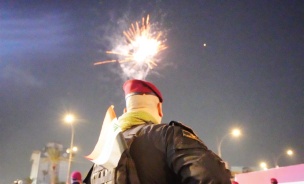









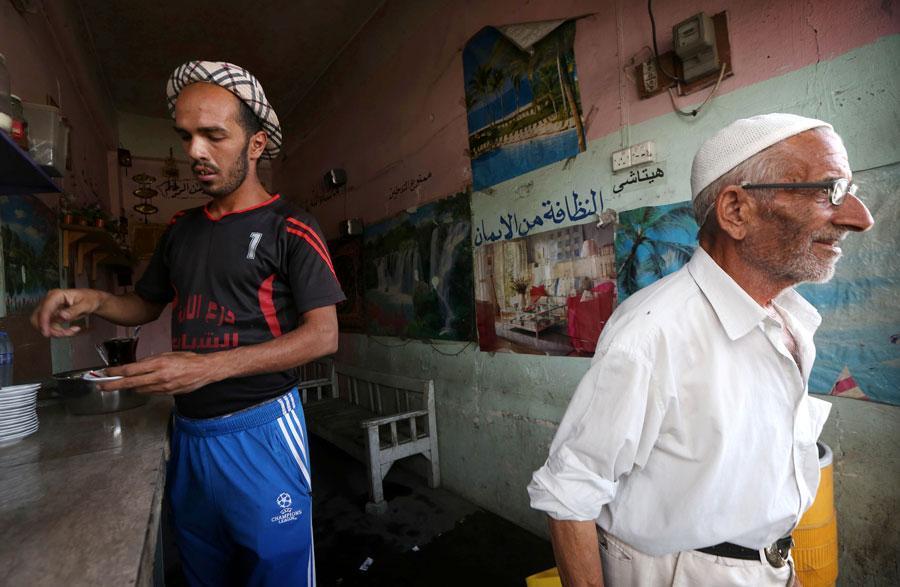
An Iraqi man leaves a cafe in the old city in western Mosul on July 30, 2017. SAFIN HAMED/AFP/Getty Images
Iraq
Muqtada Al-Sadr Travels to Saudi Arabia
On July 30, Shi’i Iraqi cleric Muqtada Al-Sadr travelled to Saudi Arabia to meet with Crown Prince Mohammed bin Salman bin Abdulaziz Al-Saud and others in Jeddah, his first visit in 11 years. A statement released by Al-Sadr’s office said, “We have been very pleased with what we found to be a positive breakthrough in the Saudi-Iraqi relations, and we hope it is the beginning of the retreat of sectarian strife in the Arab-Islamic region.” The visit is part of a new initiative between the two neighboring countries to ease tensions stemming from Iran’s increased influence over Iraq since the U.S.-led invasion of 2003.
ISIS Attacks Iraqi Embassy in Afghanistan
On July 31, an ISIS suicide bomber blew himself up outside the Iraqi Embassy in Kabul, Afghanistan. Three armed men then entered the building and began a shootout that lasted four hours, during which several other bombs exploded in the area. All of the attackers were eventually killed by Afghan security forces, and the embassy was heavily damaged.
Iraqi General Expects Tal Afar Fight to be Easier than Mosul
According to Iraqi Maj. Gen. Najm Al-Jabouri, ISIS in Iraq is “worn out and demoralized.” Speaking about the next battle against ISIS, in the city of Tal Afar, he predicted, “I don’t think it will be a fierce battle, even though the enemy is surrounded.” Up to 2,000 ISIS fighters are in Tal Afar, he said, but the city is not as narrow and crowded as Mosul, Iraq’s second largest city.
Iraqi Kurdish Government Opposes Kirkuk-Iran Oil Pipeline
After the governments of Iraq and Iran agreed on July 30 to form a joint committee to study the construction of a pipeline shipping Kirkuk oil to Iran, Dilshad Shaaban, deputy chairman of the Kurdistan Regional Parliament’s Committee on Natural Resources and Energy, charged that the committee is a violation of U.S. sanctions on Iran. Nor, he added, was the Kurdistan Regional Government (KRG) informed of the agreement in advance. Shaaban questioned whether Kirkuk would even be part of Iraq after September’s Kurdish independence referendum, which he accused Baghdad and Tehran of trying to undermine.
—Alex Shanahan
Iran
Iran Vows “Proportional Reaction” to New Sanctions, Claims JCPOA Violation
The Iranian government has vowed “proportional” retaliation following the enactment of new U.S. sanctions against it, which they claim violate the JCPOA, otherwise known as the “Iran deal.” The sanctions against Iran, Russia and North Korea, overwhelmingly passed by Congress and begrudgingly signed by U.S. President Donald Trump on July 2, deal mostly with Iran’s nascent missile program. U.S. members of Congress argue that the sanctions deal with malicious behavior by Iran that is distinct from its nuclear program.
U.S., Allies Ramp Up Pressure Amid Iranian Satellite Launch
The U.S., joined by envoys from Britain, France and Germany, has filed a complaint letter with U.N. Secretary General Antonio Guterres concerning Iran’s recent satellite launch, claiming that the satellite was “inherently capable of delivering a nuclear warhead” and, as such, violated the JCPOA. The complaint, which accuses Iran of violating U.N. Security Council Resolution 2231, is considered by many to be part of U.S. President Donald Trump’s attempts to sabotage the JCPOA by falsely claiming that Iran has violated the deal.
U.S. Opens Investigation into Amazon for Alleged Iran Sanctions Violation
American e-commerce giant Amazon publicly disclosed that, between January 2012 and June 2017, it sold nearly $25,000 worth of merchandise to Iran, meaning that the company violated the Iran Threat Reduction and Syria Human Rights Act of 2012. The act mandates that all companies that do business with Iran disclose their transactions, which Amazon had previously failed to do. Amazon CEO Jeff Bezos has indicated that he fully intends to comply with the Treasury Department investigation.
U.S. Navy Hits Back at Iranian Report, Calls Warning Shot “Safe and Professional”
The U.S. Navy, responding to an Iranian news report stating that warning shots fired by U.S. aircraft patrolling the Persian Gulf were “unprofessional” and potentially unsafe, has issued a statement declaring the shots “safe and professional.” The warning shots were fired Aug. 1 by U.S. helicopters at Iranian vessels that were allegedly approaching American ships at “a high rate of speed.” This prompted retaliatory fire from Iranian ships, which unloaded shots into the water adjacent to the U.S. ships.
U.S. to Seek Additional Nuclear Inspections
The United States is reportedly looking to ramp up inspections of Iranian military facilities in hopes of testing the limits of Iran’s compliance with the JCPOA. The inspections—which the U.S. cannot unilaterally mandate under the JCPOA—are in line with the Trump administration’s more aggressive approach to Iran, which has resulted in various military and diplomatic squabbles. It is speculated that Tehran’s potential rejection of more inspections could provide Trump with a reason to scrap the deal. In order to force inspections, however, Washington needs the support of a majority of the countries that signed the JCPOA. Thus far these nations say the U.S. has not provided any compelling evidence of Iranian efforts to violate the deal.
—David DePriest