















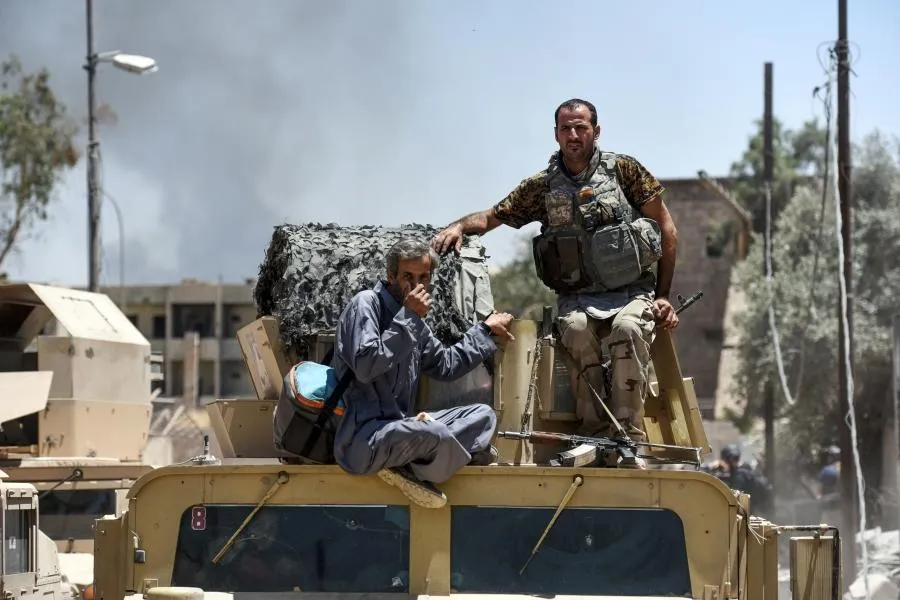
A displaced Iraqi man is escorted by Iraqi forces after fleeing his home in Mosul's western Al-Shifa district on June 15, 2017, during the ongoing offensive by Iraqi forces to retake the city from ISIS fighters. MOHAMED EL-SHAHED/AFP/Getty Images
Iran:
- Days after a devastating ISIS terror attack in Tehran, Iranian Foreign Minister Mohammad Javad Zarif accused Saudi Arabia of supporting terrorist militants within Iran. Zarif went on to blame the U.S. and the Western world in general for mounting hostilities between Muslim nations. Parliament Speaker Ali Larijani also criticized the anti-Iran focus of President Donald Trump’s recent visit to Riyadh, the recent U.S.-Saudi arms deal, and the U.S. Senate vote to move ahead on new Iran sanctions.
- The Iranian government claims to have taken out the mastermind of the June 7 terror attacks on the parliament, according to Intelligence Minister Mahmoud Alavi. The assault which left 17 dead and 50 wounded, was orchestrated by ISIS. Scrutiny has been directed at Salafis in Iranian Kurdistan, as government raids in the region have taken place to quell potential follow-up attacks. The following Friday, the Iranian Intelligence Ministry arrested 41 people in Tehran and Kurdish provinces in relation to the attacks.
- In May, Iran exported 1.1 million barrels per day (bpd) of oil to Europe, the most since the lifting of sanctions as part of the Joint Comprehensive Plan of Action nuclear deal. The Europe numbers almost equaled the 1.2 million bpd Iran sent to Asia.
- An Iranian warship engaged two U.S. Navy vessels, shining a spotlight and a laser at the U.S. military helicopter that was accompanying them in international waters in the Strait of Hormuz. The June 14 incident, deemed by U.S. officials as “unsafe and unprofessional,” echoed a similar encounter between U.S. surveillance ships and Iranian vessels that took place in March. The incident, while vaguely hostile, did not escalate further.
—Compiled by David DePriest
Iraq:
- Human Rights Watch said on June 14 that the U.S.-led coalition had used white phosphorus in anti-ISIS operations in Mosul, Iraq, and Raqqa, Syria. The human rights group warned that using white phosphorus in civilian areas risks causing significant injury to civilians. New Zealand Brigadier General Hugh McAslan said the coalition used white phosphorus to provide a smoke screen to civilians fleeing western Mosul. White phosphorus burns at a high temperature and can burn through skin, muscle and bone. It can, however, be used to create smoke screens and mark targets.
- Approximately 800 cases of food poisoning were recorded at the Hasansham U2 refugee camp for internally displaced people near Mosul on June 13, causing 200 people to become seriously ill and be taken to the hospital. The food was made in a restaurant in Erbil, capital of Iraqi Kurdistan, and delivered by a Qatari charity. Previous rules preventing outside groups from bringing food into the camp were reversed “under great pressure.” The owner of the restaurant that prepared the food was arrested.
- On June 9, an ISIS-claimed suicide bomb killed at least 31 people and injured 35 at a market in the town of Musayab. Another ISIS-claimed suicide bomb at a bus station in Karbala wounded four people on the same day.
- ISIS attacked the town of Shirqat on June 10, killing 38 individuals, both civilian and military, and injuring around 40 more. Also killed in the attack, which Iraqi troops eventually turned back, were 24 ISIS members.
— Compiled by Alex Shanahan















