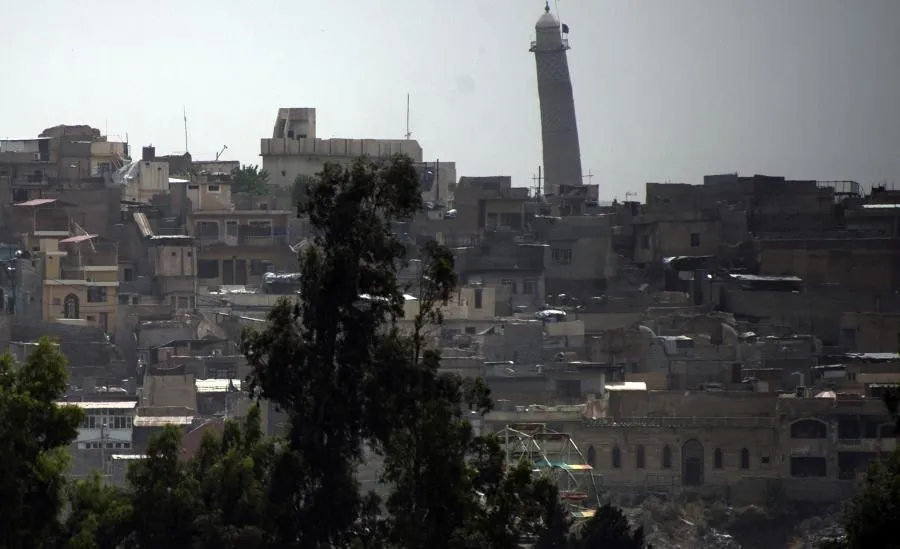
A leaning minaret in the war-ravaged city of Mosul, May 19, 2017. AFP PHOTO / FADEL SENNA
Iraq
ISIS destroys historic Mosul mosque
On June 22, ISIS, commonly referred to as Da’ish, blew up the historic 12th century al-Nuri mosque in Mosul’s Old City. ISIS leader Abu Bakr Al-Baghdadi announced the creation of the ISIS “caliphate” from that very mosque in 2014. Iraqi Prime Minister Haider Al-Abadi tweeted, “Da’ish’s bombing of the al-Habda minaret and the al-Nuri mosque is a formal declaration of defeat.”
Iraq begins clearing last Mosul district
On June 18, Iraqi troops began their fight to secure Mosul’s Old City, which is now the last remaining district of the city still under ISIS control. On June 20, the Iraqi army recaptured the Mosul district of Al-Shifaa, meaning that the Old City is now completely surrounded by Iraqi troops. Approximately 300 ISIS fighters are still believed to be in the Old City, along with 100,000 civilians. The district is heavily populated and fighting will be slow in the narrow streets.
EU may play a role in stabilizing post-ISIS Iraq
Iraq asked the EU to send troops to help stabilize the country after Mosul is recaptured from ISIS. The EU will discuss whether to send the EU Security Sector Reform Advice and Assist Team to train Iraqi security forces. Such a mission could “build up Iraqi counter-terrorism forces, establish functioning justice and interior ministries and give strategic security advice to the Iraqi government, as well as train police,” according to French diplomats. The European External Action Service will announce its decision and plans soon.
Iraqi prime minister visits Saudi Arabia, Iran and Kuwait
Iraqi Prime Minister Haider Al-Abadi visited Saudi Arabia, Iran, and Kuwait this week, in an effort at regional reconciliation. Following the visit to Riyadh, Iraq and Saudi Arabia will set up a “coordination council to upgrade strategic ties.” In Tehran, Iranian Supreme Leader Ayatollah Ali Khamenei told Al-Abadi not to trust the Americans and their “regional allies,” and not to disband the (heavily Shi’i) Popular Mobilization Forces fighting ISIS in Iraq.
—Compiled by Alex Shanahan
Iran
Iran conducts “retaliatory” missile strike against ISIS in Syria
Iran launched several missiles into Syria on June 18, in what is being dubbed a “retaliatory” attack against the Islamic State, which the Iranian government holds responsible for the June 7 terror attacks in Tehran. This marks the first time in more than 30 years that Iran has fired missiles at another country, and marks Iran’s first official military entry into the ongoing war in Syria and fight against ISIS. The missiles targeted the Deir Ezzor region of Syria.
Iranian missile strike puts U.S., Saudi Arabia on notice
The Iranian missile attack on Syria also served to put Saudi Arabia and the United States on notice, with General Ramazan Sharif of the Iranian Revolutionary Guard Corps saying that “The Saudis and Americans are especially receivers of this message.” He continued, “Obviously and clearly, some reactionary countries of the region, especially Saudi Arabia, had announced that they are trying to bring insecurity into Iran.” The range of the attack demonstrates Iran’s ability to strike key locations such as the Saudi capital of Riyadh and several U.S. bases in Qatar, Saudi Arabia, and Iraq. All this comes on the heels of new unilateral sanctions passed by the United States aimed at chastising Iran for its ballistic missile program, the same program that Iran is demonstrating with these strikes.
Iran invokes U.N. charter in rebuke of Tillerson
Iran’s government criticized U.S. Secretary of State Rex Tillerson for his comments last week that he supported a “peaceful” regime change in Iran. Ministry spokesman Bahram Ghassemi condemned the position as “contrary to international law and the U.N. charter. ” Iran coupled this public attack with an incendiary letter to U.N. Secretary General Guterres charging the U.S. with violating the charter.
U.S. shoots down drone days after Iranian missile launch
The United States shot down an Iranian drone in Syria on June 20, an act that Russian Deputy Foreign Minister Sergei Ryabkov dubbed as “complicity with terrorism.” The drone, which was operated by forces backing the Assad government, was shot down by an F-15 plane north of a U.S. outpost.
Rift between Ayatollah and Rouhani widens after slight
After being publicly criticized by Supreme Leader Ayatollah Ali Khamenei at a meeting of the country’s most senior officials, Iranian President Hassan Rouhani fired back this week by saying that the legitimacy of a religious leader is determined by the “people’s will and invitation” of the people. This was taken as a slight by supporters of the ayatollah. Khamenei has reportedly been unhappy with Rouhani’s more moderate agenda and his efforts to improve relations with the U.S.
—Compiled by David DePriest