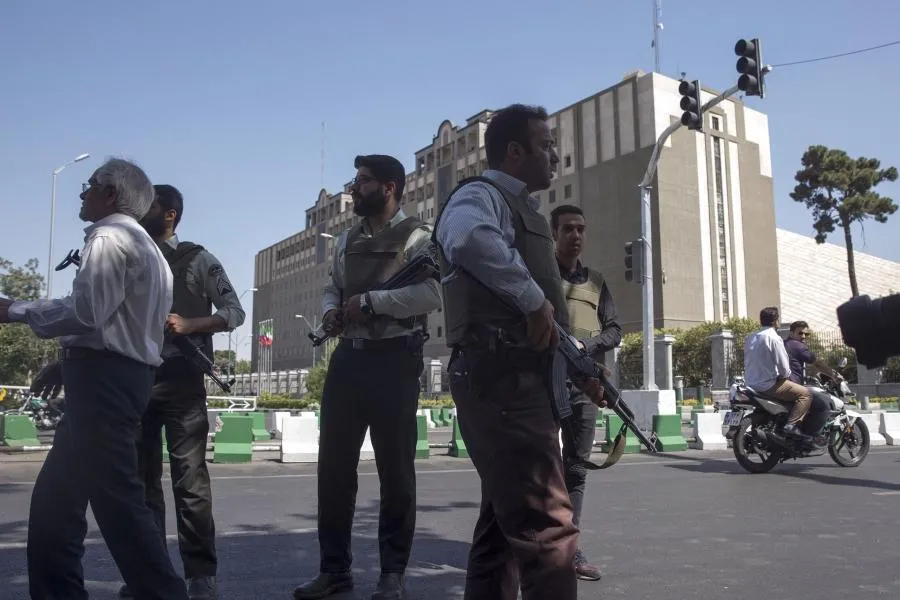
Police officers stand outside Iran's parliament building following an attack by several gunmen on June 7, 2017 in Tehran. Majid Saeedi/Getty Images
Iran:
- On June 7, ISIS claimed two simultaneous terrorist attacks in Tehran: at the Iranian parliament and the tomb of Ayatollah Ruhollah Khomeinei. Ultimately, 17 people were killed and 52 wounded with gunfire and suicide bombs. This is ISIS’ first successful attack in Iran, coming as the group faces the beginning of an assault on Raqqa and the end of one on Mosul. The four terrorists at the parliament were killed by security forces after a long standoff. Two attackers were killed and one was arrested at the tomb. More were subsequently arrested. The attackers had apparently travelled to Iraq and Syria to fight for ISIS. The Islamic Revolutionary Guard Corps blamed Saudi Arabia for the attacks. Saudi Arabia denied the accusations.
- The U.S. Senate voted 91-8 on June 7 to end debate on a bill to impose new sanctions on Iran. The bill will now go to a Senate vote possibly next week. The new sanctions are related to Iran’s ballistic missile development, arms transfers, support for terrorism, and human rights abuses. After the Senate vote, the bill will have to pass in the House of Representatives and be signed into law by the President.
- Iranian state-run media on Friday announced that Iran is in talks with the Russia-led Eurasian Economic Union (EEU) on the creation of a free-trade pact. Iran is having trouble reviving its economy even after most global sanctions against Iran were lifted, because foreign investors are still cautious about U.S. sanctions. The pact would bring Iran closer to joining the EEU.
- Iranian leaders and media reacted to the decision by several Middle Eastern countries and others to cut diplomatic and commercial relations with Qatar by blaming the U.S. and Saudi Arabia. The Chairman of the Iranian Parliament’s Committee on National Security and Foreign Policy, Alaeddin Boroujerdi, criticized U.S. President Donald Trump’s recent visit to the Middle East as interference in other countries’ affairs and also criticized the recent U.S.-Saudi weapons arms deal. The Secretary of Iran’s Expediency Council, Mohsen Rezaei, said that Saudi Arabia might invade Qatar in order to begin creating a united Arab community to oppose Persians and Turks. He claimed the U.S. and Israel support this plan. Others in Iran’s diplomatic circles called for restraint and dialogue to ease tensions.
Iraq:
- On June 7, Iraqi Kurdistan Regional Government (KRG) President Masoud Barzani announced that the KRG would have a referendum on independence from Baghdad on September 25, 2017. Baghdad will oppose the vote and the president of Iraq’s Shi’i coalition warned the KRG not to annex Kirkuk. A “yes” vote would not mean immediate independence, however, as the KRG would still have to negotiate with Baghdad.
- Iraqi Popular Mobilization Forces (PMF), with the help of the Iraqi Air Force, have taken control of the town of Baaj from ISIS. Baaj was a known hideout of ISIS leader Abu Bakr al-Baghdadi. The PMF, which have ties to Iran, are trying to cut off ISIS’ supply and communication lines to and from Syria, but also want to gain a foothold on the Iraqi-Syrian border to reopen a weapons-supply route for the Syrian army.
- Following reports from media and human rights groups claiming that Iraq used white phosphorus on more than one occasion in the battle for Mosul, the Iraqi Army denied the allegations. White phosphorus burns at high temperatures when exposed to air and can burn through human skin, muscle, and bone. It can be used to create smoke screens and to mark targets for strikes, but when used in civilian areas it can indiscriminately injure civilians. Discussing the most recent incident, which was on June 3, the Joint Operations Command of the Iraqi Army said that the army asked coalition forces to use smoke shells to protect civilians who were fleeing Mosul from ISIS snipers.
- Human Rights Watch reported that since the battle for Mosul began in October, at least 26 bodies of handcuffed and blindfolded men have been discovered in government-held parts of Mosul and the surrounding area. Sources tell the human rights group that 15 of the men were summarily executed on the suspicion of having ISIS connections by government forces. The other 11 cast suspicion on the Iraqi government because of where they were found. Another source told the group that a Sunni Popular Mobilization Forces unit is responsible for the summary execution of 25 men and dumping their bodies in the Tigris River.
- On June 6, Zeid Ra’ad Al-Hussein, the U.N. human rights chief, charged that on June 1, ISIS killed 163 civilians in the western Mosul neighborhood of al-Shira to prevent them from escaping the city. The U.N. said on Thursday that ISIS killed at least 231 civilians trying to escape Mosul from May 26 to June 3.
—Compiled by Alex Shanahan