















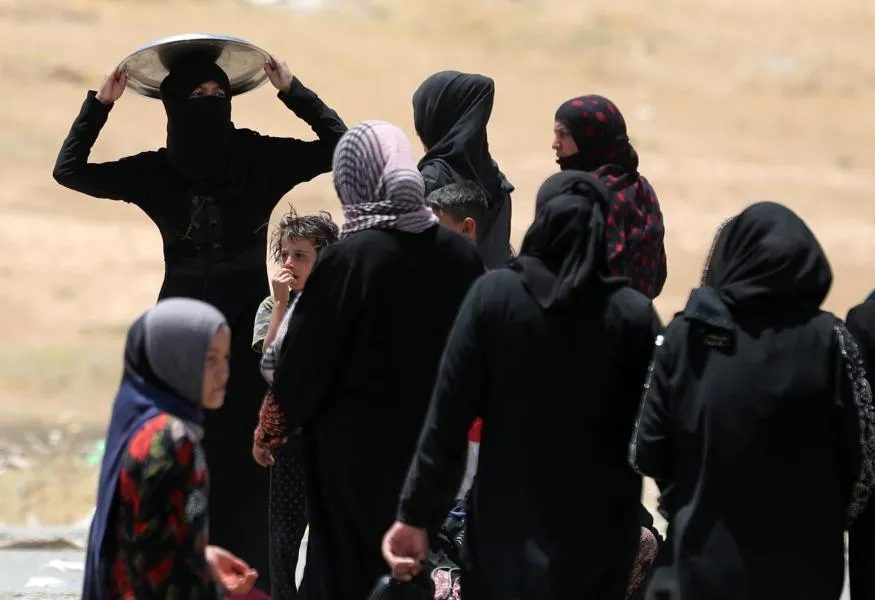
Iraqi women wait to receive food in the Al-Akrab area after leaving their homes in west Mosul on June 2, 2017, as government forces continue their offensive to retake the city from Islamic State fighters. KARIM SAHIB/AFP/Getty Images
Iraq:
- On Tuesday, a total of six bombings in and near Baghdad killed 38 people and wounded 88. Two of the bombings were car bombs claimed by ISIS and targeted Shi’i: one outside an ice cream store in the Karrada neighborhood, which killed 17 people and wounded 32, and one during rush hour outside the Public Pension Office in the Shawaka neighborhood that killed 14 people and wounded 37. The other four bombings were unclaimed. These four in total killed seven people and wounded 19.
- On Saturday, Iraqi forces started a new operation in the fight to retake Mosul from ISIS. In an attempt to rejuvenate the slowing fight, the operation will focus on the last section of Mosul still under ISIS control: the Old City and three neighboring districts. Leaflets from the Iraqi Air Force told civilians in the districts to evacuate, but many fear for their lives if they do. Staying in Mosul, however, means civilians face increasingly limited food and water, as well as attacks by ISIS.
- On Monday, Iraq’s Popular Mobilization Forces (PMF) reached the Iraqi border with Syria in the first step of an effort to take the entire border region from ISIS. The PMF took several small villages near the border. Iran, the PMF’s backer, is interested in establishing a foothold on the Iraq-Syria border to link up with Syrian government forces in the future and re-establish weapons supply lines into Syria.
- After Kurdish protesters in March seized a Kirkuk pumping station and disrupted oil production to demand that Baghdad build a new oil refinery in Kirkuk, the Iraqi oil ministry has agreed to build a new refinery in Kirkuk. The project will take three to five years and cost $5 billion. The new refinery will replace one that is 65 years old and increase refining capacity from 30,000 bpd to 70,000 bpd.
- Former Iraqi Prime Minister Nouri Al-Maliki stated in an interview with Lebanon’s al-Akhbar newspaper that Baghdad should use force if necessary to stop Kurdish President Masoud Barzani from declaring an independent Kurdish state. Many worry that after Mosul is retaken from ISIS, new rounds of fighting between Popular Mobilization Forces and the Kurdish Peshmerga could erupt.
- On Thursday, after four years, the Iraqi national soccer team played an international game inside its own territory. FIFA had previously banned international games from taking place in Iraq. The game was played in Basra against Jordan. After previous international games were cancelled because of violence, Thursday’s game represents hope for a peaceful Iraq. Iraq won the match, 3-1.
Iran:
- After talks in Lebanon between Iran and Hamas, Iran will once again financially support Hamas. Iran and Hamas are also set to restart diplomatic relations that were ended at the beginning of the Syrian civil war. Iran cut off relations as well as military and financial aid to Hamas in 2011 after Hamas refused to support Syrian President Bashar al-Assad. The New Arab and Arutz Sheva, however, report that Hamas has denied these reports.
- On Monday, Iran discovered a new oil deposit in the Central Kavir desert. Iran is currently producing 3.8 million bpd in accordance with OPEC production caps. Over the next four years, however, Iran wants to raise its production to 5 million bpd. To make this happen, Iran is currently concluding deals with foreign oil companies such as Total of France, Maersk of Denmark, Petronas of Malaysia, Pertamina of Indonesia, and Lukoil of Russia.
- On Tuesday, the deputy head of the Iranian Space Agency, Homayoon Sadr, announced that Iran would soon send satellites into space. The Iranian Space Agency has started the design of Pars satellites, which will help Iran achieve its goal of advancing its satellite technology by 2021. Additionally, Sadr noted that the Doosti satellite is ready to be launched and the Payam and Nahid 1 Telecommunication Satellites will be launched by the end of the year. According to Hassan Haddadpour, head of the Iran Space Research Center, Iran’s first sensor-operational satellite, Soha, is scheduled to be launched next year.
- On Tuesday, the Iranian Parliament voted to re-elect moderate conservative Ali Larijani as parliamentary speaker. Ali Motahari was also re-elected as first deputy of the speaker and Masoud Pezeshkian for second deputy of the speaker. The rumors that Larijani and the Rouhani administration were conspiring to block Motahari’s re-election did not come to pass and moderates and reformists were able to keep their coalition together.
—Compiled by Alex Shanahan















